 Representative ListInscribed 2008
Description
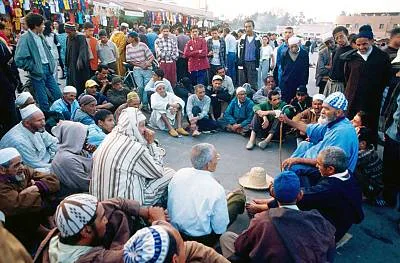
The Jemaa el-Fna Square is one of the main cultural spaces in Marrakesh and has become one of the symbols of the city since its foundation in the eleventh century. It represents a unique concentration of popular Moroccan cultural traditions performed through musical, religious and artistic expressions.
Located at the entrance of the Medina, this triangular square, which is surrounded by restaurants, stands and public buildings, provides everyday commercial activities and various forms of entertainment. It is a meeting point for both the local population and people from elsewhere. All through the day, and well into the night, a variety of services are offered, such as dental care, traditional medicine, fortune-telling, preaching, and henna tattooing; water-carrying, fruit and traditional food may be bought. In addition, one can enjoy many performances by storytellers, poets, snake-charmers, Berber musicians (mazighen), Gnaoua dancers and senthir (hajouj) players. The oral expressions would be continually renewed by bards (imayazen), who used to travel through Berber territories. They continue to combine speech and gesture to teach, entertain and charm the audience. Adapting their art to contemporary contexts, they now improvise on an outline of an ancient text, making their recital accessible to a wider audience.
The Jemaa el-Fna Square is a major place of cultural exchange and has enjoyed protection as part of Morocco’s artistic heritage since 1922. However, urbanization, in particular real estate speculation and the development of the road infrastructure, are seen as serious threats to the cultural space itself. While Jemaa el-Fna Square enjoys great popularity, the cultural practices may suffer acculturation, also caused by widespread tourism.
Located at the entrance of the Medina, this triangular square, which is surrounded by restaurants, stands and public buildings, provides everyday commercial activities and various forms of entertainment. It is a meeting point for both the local population and people from elsewhere. All through the day, and well into the night, a variety of services are offered, such as dental care, traditional medicine, fortune-telling, preaching, and henna tattooing; water-carrying, fruit and traditional food may be bought. In addition, one can enjoy many performances by storytellers, poets, snake-charmers, Berber musicians (mazighen), Gnaoua dancers and senthir (hajouj) players. The oral expressions would be continually renewed by bards (imayazen), who used to travel through Berber territories. They continue to combine speech and gesture to teach, entertain and charm the audience. Adapting their art to contemporary contexts, they now improvise on an outline of an ancient text, making their recital accessible to a wider audience.
The Jemaa el-Fna Square is a major place of cultural exchange and has enjoyed protection as part of Morocco’s artistic heritage since 1922. However, urbanization, in particular real estate speculation and the development of the road infrastructure, are seen as serious threats to the cultural space itself. While Jemaa el-Fna Square enjoys great popularity, the cultural practices may suffer acculturation, also caused by widespread tourism.
Country
MoroccoOther heritage elements in Morocco
Representative List · Inscribed 2025Moroccan Caftan: art, traditions and skillsRepresentative List · Inscribed 2024Henna: rituals, aesthetic and social practicesRepresentative List · Inscribed 2023Malhun, a popular poetic and musical artRepresentative List · Inscribed 2023Arts, skills and practices associated with engraving on metals (gold, silver and copper)Representative List · Inscribed 2022Date palm, knowledge, skills, traditions and practicesRepresentative List · Inscribed 2021Tbourida
More Representative List elements
Inscribed 2010Chhau danceInscribed 2021Traditional craftsmanship of making Dumbara Ratā KalālaInscribed 2022Al-Khanjar, craft skills and social practicesInscribed 2009Âşıklık (minstrelsy) traditionInscribed 2022Pehlevanliq culture: traditional zorkhana games, sports and wrestlingInscribed 2017Dolma making and sharing tradition, a marker of cultural identity
Also inscribed in 2008
- Cultural space of Boysun District
- Mask dance of the drums from Drametse
- Al-Sirah Al-Hilaliyyah epic
- Shashmaqom music
- Ramlila, the traditional performance of the Ramayana
- Cultural space of the Bedu in Petra and Wadi Rum
Data Source: UNESCO Intangible Cultural Heritage · UNESCO listing