 Representative ListInscribed 2008
Description
This oral poem, also known as the Hilali epic, recounts the saga of the Bani Hilal Bedouin tribe and its migration from the Arabian Peninsula to North Africa in the tenth century. This tribe held sway over a vast territory in central North Africa for more than a century before being annihilated by Moroccan rivals. As one of the major epic poems that developed within the Arabic folk tradition, the Hilali is the only epic still performed in its integral musical form. Moreover, once widespread throughout the Middle East, it has disappeared from everywhere except Egypt.
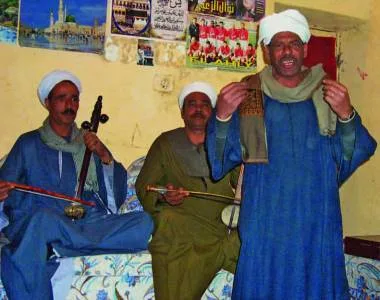
Since the fourteenth century, the Hilali epic has been performed by poets who sing the verses while playing a percussion instrument or a two-string spike fiddle (rabab). Performances take place at weddings, circumcision ceremonies and private gatherings, and may last for days. In the past, practitioners were trained within family circles and performed the epic as their only means of income. These professional poets began their ten-year apprenticeships at the age of five. To this day, students undergo special training to develop memory skills and to master their instruments. Nowadays, they must also learn to inject improvisational commentary in order to render plots more relevant to contemporary audiences.
The number of performers of the Hilali Epic is dwindling due to competition from contemporary media and to the decreasing number of young people able to commit to the rigorous training process. Pressured by the lucrative Egyptian tourist industry, poets tend to forsake the full Hilali repertory in favour of brief passages performed as part of folklore shows.
Since the fourteenth century, the Hilali epic has been performed by poets who sing the verses while playing a percussion instrument or a two-string spike fiddle (rabab). Performances take place at weddings, circumcision ceremonies and private gatherings, and may last for days. In the past, practitioners were trained within family circles and performed the epic as their only means of income. These professional poets began their ten-year apprenticeships at the age of five. To this day, students undergo special training to develop memory skills and to master their instruments. Nowadays, they must also learn to inject improvisational commentary in order to render plots more relevant to contemporary audiences.
The number of performers of the Hilali Epic is dwindling due to competition from contemporary media and to the decreasing number of young people able to commit to the rigorous training process. Pressured by the lucrative Egyptian tourist industry, poets tend to forsake the full Hilali repertory in favour of brief passages performed as part of folklore shows.
Country
EgyptOther heritage elements in Egypt
Representative List · Inscribed 2025Koshary, daily life dish and practices associated with itRepresentative List · Inscribed 2024Semsemiah: instrument crafting and playingRepresentative List · Inscribed 2024Henna: rituals, aesthetic and social practicesRepresentative List · Inscribed 2023Arts, skills and practices associated with engraving on metals (gold, silver and copper)Representative List · Inscribed 2022Date palm, knowledge, skills, traditions and practicesRepresentative List · Inscribed 2022Festivals related to the Journey of the Holy family in Egypt
More Representative List elements
Inscribed 2022Sericulture and traditional production of silk for weavingInscribed 2023Rickshaws and rickshaw painting in DhakaInscribed 2025DeepavaliInscribed 2018Horse and camel ArdhahInscribed 2016Oshi Palav, a traditional meal and its social and cultural contexts in TajikistanInscribed 2012Al-Taghrooda, traditional Bedouin chanted poetry in the United Arab Emirates and the Sultanate of Oman
Also inscribed in 2008
- Cultural space of Boysun District
- Cultural space of Jemaa el-Fna Square
- Mask dance of the drums from Drametse
- Shashmaqom music
- Ramlila, the traditional performance of the Ramayana
- Cultural space of the Bedu in Petra and Wadi Rum
Data Source: UNESCO Intangible Cultural Heritage · UNESCO listing