
 Representative ListInscribed 2008
Description
For over ten centuries, the classical music tradition of Shashmaqom has evolved in the urban centres of Central Asia formerly known as Mâwarâ al-nahr, an area which now encompasses present-day Tajikistan and Uzbekistan.
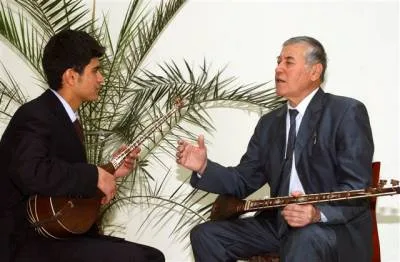
Shashmaqom, meaning “six maqoms”, constitutes a fusion of vocal and instrumental music, melodic and rhythmic idioms and poetry. The genre is performed solo or by a group of singers and an orchestra of lutes, fiddles, frame-drums and flutes. Performances generally open with an instrumental introduction followed by the nasr, the main vocal section consisting of two distinct sets of songs.
Dating back to the pre-Islamic era, Shashmaqom was continually influenced by developments in musicology, poetry, mathematics, and Sufism. So popular was the maqom system in the ninth and tenth centuries that numerous music schools were founded, mainly by the Jewish community, in the city of Bukhara, the historical and spiritual centre of Shashmaqom. Shashmaqom genre requires specially trained musicians because the standard notation system can record only the basic framework. Consequently, oral transmission from master to student remains the principal means of preserving the music and its spiritual values.
From the 1970s, many of the best-known Shashmaqom performers emigrated from Tajikistan and Uzbekistan to diaspora communities in Israel and the United States. Since Uzbekistan and Tajikistan gained independence in 1991, many measures have been taken to safeguard Shashmaqom. Only a few performers have maintained local performance styles as taught by independent teachers. With the passing of many Shashmaqom masters, the overwhelming majority of presentday performers in Tajikistan and Uzbekistan are graduates of the Tashkent Conservatory, which offers training in Shashmaqom composition.
Shashmaqom, meaning “six maqoms”, constitutes a fusion of vocal and instrumental music, melodic and rhythmic idioms and poetry. The genre is performed solo or by a group of singers and an orchestra of lutes, fiddles, frame-drums and flutes. Performances generally open with an instrumental introduction followed by the nasr, the main vocal section consisting of two distinct sets of songs.
Dating back to the pre-Islamic era, Shashmaqom was continually influenced by developments in musicology, poetry, mathematics, and Sufism. So popular was the maqom system in the ninth and tenth centuries that numerous music schools were founded, mainly by the Jewish community, in the city of Bukhara, the historical and spiritual centre of Shashmaqom. Shashmaqom genre requires specially trained musicians because the standard notation system can record only the basic framework. Consequently, oral transmission from master to student remains the principal means of preserving the music and its spiritual values.
From the 1970s, many of the best-known Shashmaqom performers emigrated from Tajikistan and Uzbekistan to diaspora communities in Israel and the United States. Since Uzbekistan and Tajikistan gained independence in 1991, many measures have been taken to safeguard Shashmaqom. Only a few performers have maintained local performance styles as taught by independent teachers. With the passing of many Shashmaqom masters, the overwhelming majority of presentday performers in Tajikistan and Uzbekistan are graduates of the Tashkent Conservatory, which offers training in Shashmaqom composition.
Countries & Communities
UzbekistanTajikistanOther heritage elements in Uzbekistan
Representative List · Inscribed 2025Traditional knowledge and skills in making Kyrgyz, Kazakh and Karakalpak yurts (Turkic nomadic dwellings)Urgent Safeguarding List · Inscribed 2025Art of crafting and playing KobyzRepresentative List · Inscribed 2024Nawrouz, Novruz, Nowrouz, Nowrouz, Nawrouz, Nauryz, Nooruz, Nowruz, Navruz, Nevruz, Nowruz, NavruzRepresentative List · Inscribed 2024Art of crafting and playing rubab/rababRepresentative List · Inscribed 2023Iftar/Eftari/Iftar/Iftor and its socio-cultural traditionsRepresentative List · Inscribed 2023Art of illumination: Təzhib/Tazhib/Zarhalkori/Tezhip/Naqqoshlik
More Representative List elements
Inscribed 2016Oshi Palav, a traditional meal and its social and cultural contexts in TajikistanInscribed 2024Craftsmanship of Aleppo Ghar soapInscribed 2018Horse and camel ArdhahInscribed 2016Almezmar, drumming and dancing with sticksInscribed 2008Mak Yong theatreInscribed 2021Traditional craft skills and arts of Al-Naoor
Also inscribed in 2008
- Cultural space of Boysun District
- Cultural space of Jemaa el-Fna Square
- Mask dance of the drums from Drametse
- Al-Sirah Al-Hilaliyyah epic
- Ramlila, the traditional performance of the Ramayana
- Cultural space of the Bedu in Petra and Wadi Rum
Data Source: UNESCO Intangible Cultural Heritage · UNESCO listing