 Representative ListInscribed 2021
Description
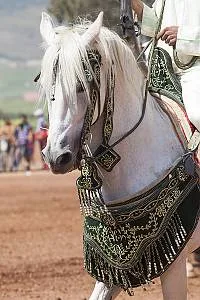
Tbourida is a Moroccan equestrian performance dating back to the sixteenth century. It simulates a succession of military parades, reconstructed according to ancestral Arab-Amazigh conventions and rituals. Each tbourida is performed by a troupe made up of an odd number of riders and horses (between 15 and 25). The riders line up side by side, with the leader of the troupe in the middle. They often give spiritual significance to the event, performing ablutions and praying collectively beforehand. Under the direction of the leader, the riders and horses perform a parade composed of two principal parts. The first is the hadda, or salute, in which the riders enter the course at a trot and perform an acrobatic arms drill, then reposition themselves at the starting point. This is followed by the talqa, in which the troupes set off again at a gallop and fire a round of blanks from their rifles, simulating a collective departure for war. The riders wear period costumes and accessories, including a turban, draped clothing and oriental slippers. They also carry a small copy of the Koran and an ancient Arab sword. The horses are bridled and saddled with material sewn and decorated in the traditional manner. The riders’ customs and costumes represent their tribe or region, and transmission takes place from generation to generation within families, through oral traditions and by observation.
Country
MoroccoOther heritage elements in Morocco
Representative List · Inscribed 2025Moroccan Caftan: art, traditions and skillsRepresentative List · Inscribed 2024Henna: rituals, aesthetic and social practicesRepresentative List · Inscribed 2023Malhun, a popular poetic and musical artRepresentative List · Inscribed 2023Arts, skills and practices associated with engraving on metals (gold, silver and copper)Representative List · Inscribed 2022Date palm, knowledge, skills, traditions and practicesRepresentative List · Inscribed 2021Arabic calligraphy: knowledge, skills and practices
More Representative List elements
Inscribed 2010Traditional art of Azerbaijani carpet weaving in the Republic of AzerbaijanInscribed 2015Majlis, a cultural and social spaceInscribed 2024Semsemiah: instrument crafting and playingInscribed 2025Bisht (men's Abaa): skills and practicesInscribed 2015Epic art of GoroglyInscribed 2008Ramlila, the traditional performance of the Ramayana
Also inscribed in 2021
- Falconry, a living human heritage
- Traditional craft skills and arts of Al-Naoor
- Bakhshi art
- Nomad games, rediscovering heritage, celebrating diversity
- Fjiri
- Durga Puja in Kolkata
Data Source: UNESCO Intangible Cultural Heritage · UNESCO listing