 Representative ListInscribed 2016
Description
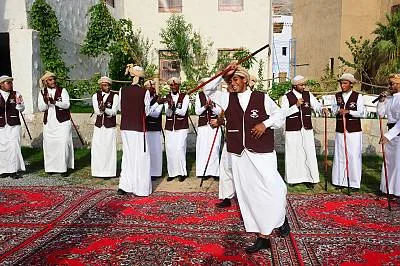
Almezmar is a traditional group performance practised by members of the Hijazi community in Saudi Arabia for festive occasions, such as family and national celebrations, religious holidays or government events. It involves about 15 to 100 practitioners dressed in long white garments who begin by standing in two rows opposite each other. When beating drums are heard, the leader of each row starts to clap and chant loudly songs about gallantry, generosity or love. The first row of performers repeats the song with strong clapping, then the second row sings antiphonally. Two performers go to the centre, twirling large sticks in quick, graceful moves, sometimes around a fire or objects then two others follow. Women participate in some of the costume making and may take part in the singing and dancing in private gatherings, while local craftspeople produce the drums and sticks used. The tradition is passed down to younger generations through observation and practice mainly by performing arts troupes and heritage centres. Almezmar is a cultural expression that acts as a marker of community identity, brings together people from diverse backgrounds, is a source of entertainment and offers shared knowledge that provides a part of the community’s collective memory.
Country
Saudi ArabiaOther heritage elements in Saudi Arabia
Representative List · Inscribed 2025Arabic KohlRepresentative List · Inscribed 2025Traditional weaving of Al SaduRepresentative List · Inscribed 2025Bisht (men's Abaa): skills and practicesRepresentative List · Inscribed 2024Semsemiah: instrument crafting and playingRepresentative List · Inscribed 2024Arabic coffee, a symbol of generosityRepresentative List · Inscribed 2024Cultural practices related to Taif roses
More Representative List elements
Inscribed 2025Moroccan Caftan: art, traditions and skillsInscribed 2022Date palm, knowledge, skills, traditions and practicesInscribed 2008Moussem of Tan-TanInscribed 2008Iraqi MaqamInscribed 2024Art of crafting and playing rubab/rababInscribed 2023Craftsmanship of mother of pearl inlay
Also inscribed in 2016
- Flatbread making and sharing culture: Lavash, Katyrma, Jupka, Yufka
- Khidr Elias feast and its vows
- Oshi Palav, a traditional meal and its social and cultural contexts in Tajikistan
- Palov culture and tradition
- Mangal Shobhajatra on Pahela Baishakh
- Tahteeb, stick game
Data Source: UNESCO Intangible Cultural Heritage · UNESCO listing