 Representative ListInscribed 2008
Description
The Azerbaijani Mugham is a traditional musical form, characterized by a large degree of improvisation. The Mugham, though a classical and academic art, draws upon popular bard melodies, rhythms and performance techniques and is performed in many venues throughout the country.
Contemporary representations of the Azerbaijani Mugham reflect different periods of Azerbaijan’s history and its contacts with Persians, Armenians, Georgians and with other Turkic peoples. This musical genre shares artistic characteristics with the Iraqi Maqam, the Persian Radif and the Turkish Makams. In the past, Mugham was primarily performed on two secular occasions: the toy, the traditional wedding feast and the majles, a gathering of connoisseurs in private settings. It was also cultivated by members of the Sufi orders and by performers of religious dramas known as ta’zie or shabih. Official competitions and informal contests served to establish the reputation of accomplished musicians.
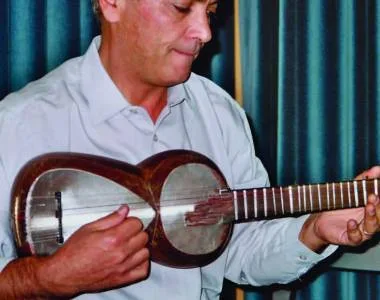
This modal genre features a male or female singer accompanied by musicians playing traditional instruments, such as the tar (a long-neck lute), the kamancha (a four-string spiked fiddle) and the daf (a type of large tambourine). Since Mugham cannot be transcribed in a fixed form, multiple versions are transmitted by masters who train students in the fine art of interpretation to ensure the variety of this artistic expression.
The Mugham has lost some of its aesthetic and expressive characteristics largely due to European influences, which are particularly apparent in the manner in which contemporary musicians perform and transmit their skills to the younger generations.
Contemporary representations of the Azerbaijani Mugham reflect different periods of Azerbaijan’s history and its contacts with Persians, Armenians, Georgians and with other Turkic peoples. This musical genre shares artistic characteristics with the Iraqi Maqam, the Persian Radif and the Turkish Makams. In the past, Mugham was primarily performed on two secular occasions: the toy, the traditional wedding feast and the majles, a gathering of connoisseurs in private settings. It was also cultivated by members of the Sufi orders and by performers of religious dramas known as ta’zie or shabih. Official competitions and informal contests served to establish the reputation of accomplished musicians.
This modal genre features a male or female singer accompanied by musicians playing traditional instruments, such as the tar (a long-neck lute), the kamancha (a four-string spiked fiddle) and the daf (a type of large tambourine). Since Mugham cannot be transcribed in a fixed form, multiple versions are transmitted by masters who train students in the fine art of interpretation to ensure the variety of this artistic expression.
The Mugham has lost some of its aesthetic and expressive characteristics largely due to European influences, which are particularly apparent in the manner in which contemporary musicians perform and transmit their skills to the younger generations.
Country
AzerbaijanOther heritage elements in Azerbaijan
Representative List · Inscribed 2024Nawrouz, Novruz, Nowrouz, Nowrouz, Nawrouz, Nauryz, Nooruz, Nowruz, Navruz, Nevruz, Nowruz, NavruzRepresentative List · Inscribed 2024Tandir craftsmanship and bread baking in AzerbaijanRepresentative List · Inscribed 2023Craftsmanship and performing art of balaban/meyRepresentative List · Inscribed 2023Iftar/Eftari/Iftar/Iftor and its socio-cultural traditionsRepresentative List · Inscribed 2023Art of illumination: Təzhib/Tazhib/Zarhalkori/Tezhip/NaqqoshlikRepresentative List · Inscribed 2023Craftsmanship of mother of pearl inlay
More Representative List elements
Inscribed 2009Katta AshulaInscribed 2025The art of breeding Turkmen alabayInscribed 2023Procession and celebrations of Prophet Mohammed's birthday in SudanInscribed 2021Traditional craft skills and arts of Al-NaoorInscribed 2020Traditional intelligence and strategy game: Togyzqumalaq, Toguz Korgool, Mangala/GöçürmeInscribed 2021Tbourida
Also inscribed in 2008
- Cultural space of Boysun District
- Cultural space of Jemaa el-Fna Square
- Mask dance of the drums from Drametse
- Al-Sirah Al-Hilaliyyah epic
- Shashmaqom music
- Ramlila, the traditional performance of the Ramayana
Data Source: UNESCO Intangible Cultural Heritage · UNESCO listing