 Representative ListInscribed 2025
Description
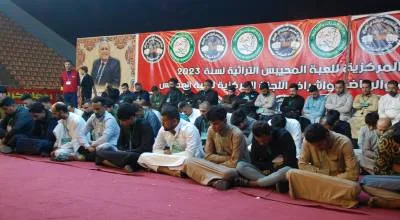
Al-Muhaibis is a popular game that tests players’ insight and intelligence. It is typically played during the month of Ramadan, after the Tarawih prayers. The game involves two teams sitting across from each other. A random draw determines which team goes first. The captain of the first team hides a ring in one of the team member’s hands, and the opposing team must find the ring through a process of elimination. If the opposing team finds the ring, it earns a point. If the opposing team eliminates the player with the ring, it loses a point, and the other team earns the point. The game continues until one of the teams reaches the pre-agreed point total. The game is accompanied by songs, chants and enthusiastic cheering.
The game is formally transmitted through annual championships organized by the Central Committee of Al-Muhaibis, with broad community participation and media coverage. Informally, it is passed down within families, with children learning by playing at home or attending competitions. While people of all genders participate, women usually join in family settings or cheer on the teams during competitions. The game strengthens social bonds and is an important part of cultural identity, especially during Ramadan.
The game is formally transmitted through annual championships organized by the Central Committee of Al-Muhaibis, with broad community participation and media coverage. Informally, it is passed down within families, with children learning by playing at home or attending competitions. While people of all genders participate, women usually join in family settings or cheer on the teams during competitions. The game strengthens social bonds and is an important part of cultural identity, especially during Ramadan.
Country
IraqOther heritage elements in Iraq
Representative List · Inscribed 2025Arabic KohlRepresentative List · Inscribed 2025Bisht (men's Abaa): skills and practicesRepresentative List · Inscribed 2025The zaffa in the traditional weddingRepresentative List · Inscribed 2024Nawrouz, Novruz, Nowrouz, Nowrouz, Nawrouz, Nauryz, Nooruz, Nowruz, Navruz, Nevruz, Nowruz, NavruzRepresentative List · Inscribed 2024Henna: rituals, aesthetic and social practicesRepresentative List · Inscribed 2023Traditional craft skills and arts of Al-Mudhif building
More Representative List elements
Inscribed 2019Ak-kalpak craftsmanship, traditional knowledge and skills in making and wearing Kyrgyz men’s headwearInscribed 2024Tradition of Nabulsi soap making in PalestineInscribed 2024Craftsmanship of Aleppo Ghar soapInscribed 2025Traditional knowledge and cultural contexts of making Maksym, a traditional Kyrgyz beverageInscribed 2014Traditional brass and copper craft of utensil making among the Thatheras of Jandiala Guru, Punjab, IndiaInscribed 2022Yaldā/Chella
Also inscribed in 2025
- Traditional Saree weaving art of Tangail
- Boreendo, Bhorindo: ancient dying folk musical instrument, its melodies, knowledge, and skills
- The zaffa in the traditional wedding
- Bisht (men's Abaa): skills and practices
- Kithul Madeema/Kithul Kapeema, an ancient indigenous technology for tapping Kithul in Sri Lanka
- Culture of Sumanak/Sumalak cooking
Data Source: UNESCO Intangible Cultural Heritage · UNESCO listing