 Urgent Safeguarding ListInscribed 2025
Description
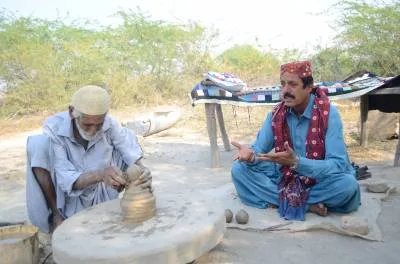
The boreendo, or bhorindo, is a traditional musical instrument that is deeply rooted in village life and nature amongst the Thari community. It has a hollow, spherical shape with sound holes, and is made of clay that is sun dried and kiln fired. It is played by men, while women are involved in decorating the instrument with clay paint. The boreendo produces sound when air is blown into it, and its tone can be adjusted by tilting the mouthpiece. Its size affects its sound, and recent changes include extra holes to widen its musical range.
The boreendo is mainly played at winter bonfires, weddings and festivals. The related knowledge and skills were traditionally passed down within certain families through hands-on learning, and some teaching now happens through village schools, guest lectures, cultural festivals and online media. As both a musical and a symbolic instrument, the boreendo encourages community participation and helps preserve local traditions and a connection to nature.
The boreendo is mainly played at winter bonfires, weddings and festivals. The related knowledge and skills were traditionally passed down within certain families through hands-on learning, and some teaching now happens through village schools, guest lectures, cultural festivals and online media. As both a musical and a symbolic instrument, the boreendo encourages community participation and helps preserve local traditions and a connection to nature.
Country
PakistanOther heritage elements in Pakistan
Representative List · Inscribed 2024Nawrouz, Novruz, Nowrouz, Nowrouz, Nawrouz, Nauryz, Nooruz, Nowruz, Navruz, Nevruz, Nowruz, NavruzRepresentative List · Inscribed 2021Falconry, a living human heritageUrgent Safeguarding List · Inscribed 2018Suri Jagek (observing the sun), traditional meteorological and astronomical practice based on the observation of the sun, moon and stars in reference to the local topography
More Urgent Safeguarding List elements
Inscribed 2012Ala-kiyiz and Shyrdak, art of Kyrgyz traditional felt carpetsInscribed 2013Chovqan, a traditional Karabakh horse-riding game in the Republic of AzerbaijanInscribed 2023Traditional knowledge, methods and practices concerning olive cultivationInscribed 2020Handmade weaving in Upper Egypt (Sa'eed)Inscribed 2025Art of crafting and playing KobyzInscribed 2023Mek Mulung
Also inscribed in 2025
- Traditional Saree weaving art of Tangail
- The zaffa in the traditional wedding
- Al-Muhaibis: social practices and traditions associated with it
- Bisht (men's Abaa): skills and practices
- Kithul Madeema/Kithul Kapeema, an ancient indigenous technology for tapping Kithul in Sri Lanka
- Culture of Sumanak/Sumalak cooking
Data Source: UNESCO Intangible Cultural Heritage · UNESCO listing