 Representative ListInscribed 2010
Description
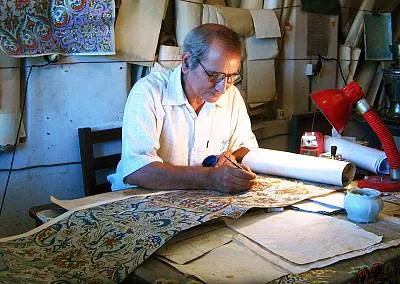
Long a centre for fine carpets, Kashan has almost one in three residents employed in carpet-making, with more than two-thirds of the carpet-makers being women. The carpet-weaving process starts with a design, elaborated from among a series of established styles, including motifs such as flowers, leaves, branches, animals and scenes taken from history. Woven on a loom known as a ''dar,'' the warp and woof are of cotton or silk. The pile is made by knotting wool or silk yarns to the warp with the distinctive Farsi knot, then held in place by a row of the woven woof, and beaten with a comb. The Farsi weaving style (also known as asymmetrical knotting) is applied with exemplary delicacy in Kashan, so that the back side of the carpet is finely and evenly knotted. The colours of Kashan carpets come from a variety of natural dyes including madder root, walnut skin, pomegranate skin and vine leaves. The traditional skills of Kashan carpet weaving are passed down to daughters through apprenticeship under instruction from their mothers and grandmothers. Apprenticeship is also the means by which men learn their skills of designing, dyeing, shearing, loom-building and tool-making.
Country
IranOther heritage elements in Iran
Representative List · Inscribed 2025Ayeneh-Kari, the art of mirror-work in Persian architectureRepresentative List · Inscribed 2024Nawrouz, Novruz, Nowrouz, Nowrouz, Nawrouz, Nauryz, Nooruz, Nowruz, Navruz, Nevruz, Nowruz, NavruzRepresentative List · Inscribed 2024Ceremony of MehreganRepresentative List · Inscribed 2024Art of crafting and playing rubab/rababRepresentative List · Inscribed 2023Iftar/Eftari/Iftar/Iftor and its socio-cultural traditionsRepresentative List · Inscribed 2023Art of illumination: Təzhib/Tazhib/Zarhalkori/Tezhip/Naqqoshlik
More Representative List elements
Inscribed 2020Art of miniatureInscribed 2013Sankirtana, ritual singing, drumming and dancing of ManipurInscribed 2019Traditional Turkish archeryInscribed 2025The zaffa in the traditional weddingInscribed 2024Traditional bagpipe (Gayda/Tulum) making and performingInscribed 2023Malhun, a popular poetic and musical art
Also inscribed in 2010
- Chhau dance
- Kalbelia folk songs and dances of Rajasthan
- Ritual dramatic art of Ta‘zīye
- Semah, Alevi-Bektaşi ritual
- Mudiyettu, ritual theatre and dance drama of Kerala
- Music of the Bakhshis of Khorasan
Data Source: UNESCO Intangible Cultural Heritage · UNESCO listing