 Representative ListInscribed 2023
Description
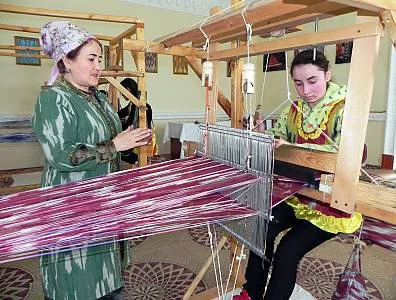
Atlas and adras are two kinds of traditional woven fabrics produced in Tajikistan. Atlas is made from silk threads, and adras is woven with silk and cotton threads, but the technique of creating both cloths is similar. There are many steps in the process, from gathering cocoons and collecting cotton, to spinning, wrapping, dyeing and weaving the threads by hand. Dresses prepared from atlas and adras cloths are widely used by women and girls during celebrations, in the workplace, in schools and at home. Traditionally, the knowledge and skills related to the production of the atlas and adras are transmitted within families or in production centres. It takes three to five months to acquire the weaving skills. During this period, students practise the weaving of simple fabrics with elementary ornaments. The practice can also be transmitted formally in schools and colleges, and through participation in atlas and adras festivals. The fabrics are popular cloths among Tajik women, who consider them as part of their cultural identity. Women usually wear clothes made from atlas and adras in official ceremonies, festivals, traditional holidays, social gatherings and events. The transmission of the element to younger generations promotes unity and collaboration among people from different regions.
Country
TajikistanOther heritage elements in Tajikistan
Representative List · Inscribed 2025Culture of Sumanak/Sumalak cookingRepresentative List · Inscribed 2024Nawrouz, Novruz, Nowrouz, Nowrouz, Nawrouz, Nauryz, Nooruz, Nowruz, Navruz, Nevruz, Nowruz, NavruzRepresentative List · Inscribed 2024Ceremony of MehreganRepresentative List · Inscribed 2024Art of crafting and playing rubab/rababRepresentative List · Inscribed 2023Art of illumination: Təzhib/Tazhib/Zarhalkori/Tezhip/NaqqoshlikRepresentative List · Inscribed 2023Sadeh/Sada celebration
More Representative List elements
Inscribed 2018Horse and camel ArdhahInscribed 2017Art of crafting and playing with Kamantcheh/Kamancha, a bowed string musical instrumentInscribed 2020Al Aflaj, traditional irrigation network system in the UAE, oral traditions, knowledge and skills of construction, maintenance and equitable water distributionInscribed 2017Al-Qatt Al-Asiri, female traditional interior wall decoration in Asir, Saudi ArabiaInscribed 2016Flatbread making and sharing culture: Lavash, Katyrma, Jupka, YufkaInscribed 2023Garba of Gujarat
Also inscribed in 2023
- Traditional knowledge, methods and practices concerning olive cultivation
- Procession and celebrations of Prophet Mohammed's birthday in Sudan
- Art of Akhal-Teke horse breeding and traditions of horses' decoration
- Harees dish: know-how, skills and practices
- Ceramic arts in Uzbekistan
- Craftsmanship of mother of pearl inlay
Data Source: UNESCO Intangible Cultural Heritage · UNESCO listing