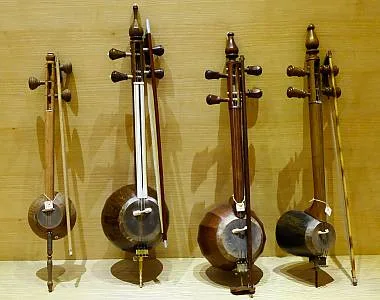

 Representative ListInscribed 2017
Description
The art of crafting and playing with Kamantcheh/Kamancha (‘little bow’), a bowed string instrument, has existed for over 1,000 years. In the Islamic Republic of Iran and Azerbaijan, it constitutes a major element of classical and folkloric music, and performances occupy a central place in a wide number of social and cultural gatherings. Contemporary practitioners mainly use a four-stringed Kamantcheh/Kamancha comprising a body and bow made with horsehair and players perform either individually or as part of orchestras. Bearers and practitioners consist of craftspeople, amateur or professional players, and teachers and students of the element. Kamantcheh/Kamancha is an essential part of musical culture in both countries, and while crafting the instrument represents a direct source of earning a living, craftspeople also perceive the art as a strong part of the intangible cultural heritage of their communities. Through their music, performers convey many themes, from the mythological to the gnostic and the comic. Today, knowledge of performing and crafting Kamantcheh/Kamancha is transmitted both within families and in State-sponsored musical institutions and schools. Knowledge about the importance of the music in promoting cultural identity is transmitted from generation to generation in all strata of society in both countries.
Countries & Communities
AzerbaijanIranOther heritage elements in Azerbaijan
Representative List · Inscribed 2024Nawrouz, Novruz, Nowrouz, Nowrouz, Nawrouz, Nauryz, Nooruz, Nowruz, Navruz, Nevruz, Nowruz, NavruzRepresentative List · Inscribed 2024Tandir craftsmanship and bread baking in AzerbaijanRepresentative List · Inscribed 2023Craftsmanship and performing art of balaban/meyRepresentative List · Inscribed 2023Iftar/Eftari/Iftar/Iftor and its socio-cultural traditionsRepresentative List · Inscribed 2023Art of illumination: Təzhib/Tazhib/Zarhalkori/Tezhip/NaqqoshlikRepresentative List · Inscribed 2023Craftsmanship of mother of pearl inlay
More Representative List elements
Inscribed 2016Palov culture and traditionInscribed 2021FjiriInscribed 2021Traditional craftsmanship of making Dumbara Ratā KalālaInscribed 2023Art of illumination: Təzhib/Tazhib/Zarhalkori/Tezhip/NaqqoshlikInscribed 2023Harees dish: know-how, skills and practicesInscribed 2012Cherry festival in Sefrou
Also inscribed in 2017
- Kumbh Mela
- Dolma making and sharing tradition, a marker of cultural identity
- Whistled language
- Al Azi, art of performing praise, pride and fortitude poetry
- Traditional art of Shital Pati weaving of Sylhet
- Kok boru, traditional horse game
Data Source: UNESCO Intangible Cultural Heritage · UNESCO listing