Mariachi: UNESCO Intangible Cultural Heritage (File 00575) — Mexico’s Living Musical Tradition
Mariachi — Mexico’s most internationally recognized musical tradition, combining violins, trumpets, vihuela, guitarrón, and guitar in elaborately costumed performing groups — was inscribed on UNESCO’s Representative List of the Intangible Cultural Heritage of Humanity in 2011 under the official designation Mariachi, string music, song and trumpet (File 00575), at the 6th session of the Intergovernmental Committee (6.COM), held in Bali, Indonesia. The inscription — formally Decision 6.COM 13.30 — recognized mariachi as a living musical tradition rooted in the western Mexican state of Jalisco, transmitted primarily from generation to generation through ear and performance, encompassing a broad repertoire from traditional jarabes and corridos to the 20th-century ranchera that made the genre Mexico’s national popular music.
- Mariachi is inscribed on UNESCO’s Representative List as File 00575, inscribed in 2011 at the 6th session of the Intergovernmental Committee (6.COM, Bali, Indonesia) — Decision 6.COM 13.30.
- The tradition originated in western Mexico, particularly in the town of Cocula, Jalisco — recognized as the “World Cradle of Mariachi” — evolving from the older son jalisciense style in the 18th–19th centuries.
- The word mariachi does not derive from the French word for “marriage” (mariage) — this theory was disproven when a Catholic priest’s letter from 1852 documented the term, predating the French intervention in Mexico by over a decade.
- The modern Mariachi ensemble’s trumpets are a 20th-century addition — introduced during the 1930s commercialization period through jazz and Cuban music influences, transforming what was originally a string-dominated rural tradition.
- UNESCO’s inscription covers Mariachi as a performing art and social practice, recognizing its transmission by ear through festive, religious, and civil events — a tradition that spread from Jalisco haciendas to become the musical emblem of Mexico.
Mariachi Origins in Jalisco, History of the Tradition, and UNESCO Inscription
Mariachi developed in western Mexico, with its origins traced to the region encompassing present-day Jalisco, Colima, Nayarit, Zacatecas, Aguascalientes, Michoacán, and Guanajuato. The town of Cocula in Jalisco has been recognized as the “World Cradle of Mariachi” (Cuna Mundial del Mariachi), and the genre evolved from the earlier son jalisciense — an 18th-century rural musical style performed at haciendas and ranches, combining Spanish melodic traditions with indigenous rhythmic elements and local instruments. The early ensemble was string-dominated: violins, harp, and the small five-string guitar called vihuela (distinct from its Renaissance namesake) formed the core, with the large bass guitar-lute called guitarrón providing the harmonic foundation.
The word mariachi itself has disputed etymology. The popular theory — that it derived from the French word mariage (marriage), given the music’s association with weddings — was effectively refuted when scholars identified a letter from a Catholic priest, written in 1852, that already used the word “mariachi” to describe the musical gatherings he found disruptive to religious observance. Since the French intervention in Mexico did not begin until 1862, the French-origin theory is chronologically impossible. Alternative etymologies propose derivation from an indigenous Nahuatl or Coca word for the wood used in the dance platforms on which the music was performed, or from a local image called “María H.” The question remains unresolved, though the 1852 documentary attestation sets a firm early date for the term.
Mariachi’s transformation from rural folk practice to urban popular music accelerated in the late 19th and early 20th centuries as musicians migrated from Jalisco to Guadalajara and then to Mexico City. The Mexican government actively promoted mariachi as a national cultural symbol from the 1920s onward, broadcasting the music on radio stations XEB and XEW. The first commercial recording of a mariachi-style ensemble — by the Cuarteto Coculense from Cocula — was made in 1908–1909. The decisive modernization came in the 1930s, when trumpets were incorporated into the ensemble through the influence of jazz and Cuban music, supplementing and ultimately displacing the harp from the standard lineup, and the genre entered Mexican cinema: film stars like Jorge Negrete and Pedro Infante became identified with the ranchera style, cementing mariachi’s national identity. The group Mariachi Vargas de Tecalitlán — formed in 1897 and still performing — became the defining professional ensemble of the genre, and when arranger Rubén Fuentes joined in the late 1940s, the formal training standard that characterizes modern professional Mariachi was established.
UNESCO’s inscription at the 6th session of the Intergovernmental Committee (6.COM) in Bali in November 2011 — Decision 6.COM 13.30 — recognized mariachi under the domains of oral traditions and expressions, performing arts, and social practices, rituals and festive events. The nomination emphasized the transmission structure of the tradition: musical knowledge is passed by ear within families and communities, with the skill flowing from fathers to sons and through performance at baptisms, weddings, quinceañeras, funerals, and civic celebrations. The inscription documented mariachi as a living practice maintained by active performance communities across western Mexico, with established international presence in the United States, Argentina, Brazil, Chile, Colombia, and Spain. For Mexico’s complete UNESCO ICH portfolio, the UNESCO intangible cultural heritage Mexico list covers all inscriptions.
Mariachi Instruments, Repertoire, and Performance Tradition
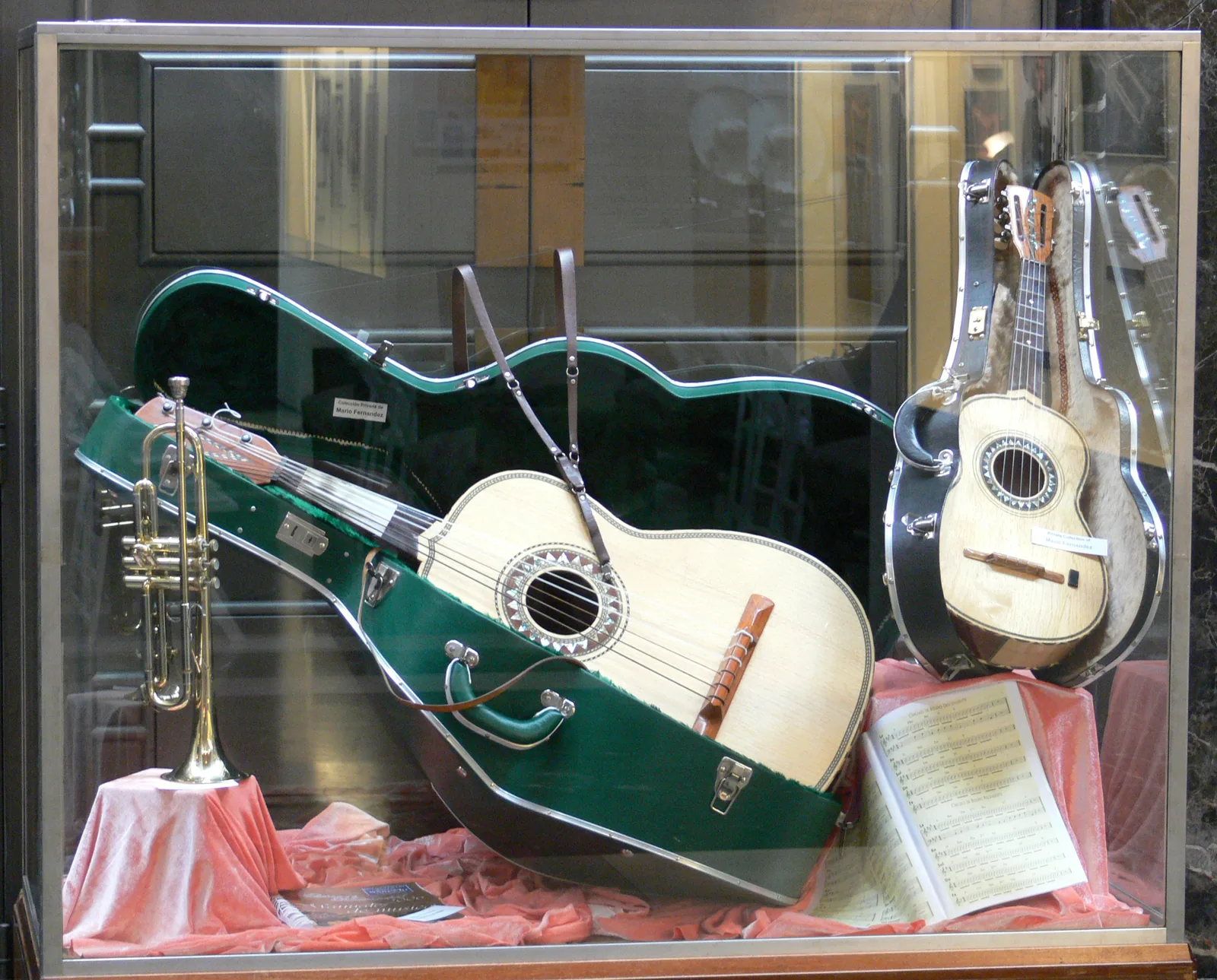
The modern Mariachi ensemble — the formation recognized in UNESCO’s inscription — consists of four to eight violins, two trumpets, a Mexican vihuela (five-string high-pitched guitar), a guitarrón (large fretless six-string acoustic bass), a standard guitar, and occasionally a Mexican folk harp. The vihuela and guitarrón are the instruments most specific to mariachi: the vihuela’s convex back and high tuning provide the rhythmic snap of the characteristic strumming pattern (rasgueado), while the guitarrón’s large resonating body produces a deep bass that anchors the ensemble without electronic amplification. These two instruments are the sonic fingerprint that distinguishes mariachi from other Mexican regional styles. The harp, once central to the classical ensemble, is now primarily associated with traditional and regional forms such as those of Nayarit and Michoacán.
The Mariachi repertoire documented in the UNESCO inscription spans centuries of musical development. The traditional repertoire includes:
- Son jalisciense: the original rural style — syncopated, dance-associated, with complex rhythmic interplay between instruments and feet on a wooden platform (tarima)
- Jarabe: a dance-song suite associated with Mexican independence and nationalism, of which the most famous is the Jarabe Tapatío (the “Mexican Hat Dance”)
- Corrido: narrative ballad — the storytelling core of Mexican folk tradition, recounting history, heroes, outlaws, and contemporary events
- Serenata (serenades): performed outside houses, particularly the mañanitas sung for birthdays and saints’ days
- Ranchera: the 20th-century popular style — emotional, direct, associated with love and patriotic themes, developed for radio, film, and the urban market
- Bolero ranchero: a slower, more romantic variant combining the Cuban bolero form with mariachi instrumentation
- Polkas, waltzes, and minuets: European dance forms absorbed into the repertoire through 19th-century cultural exchange
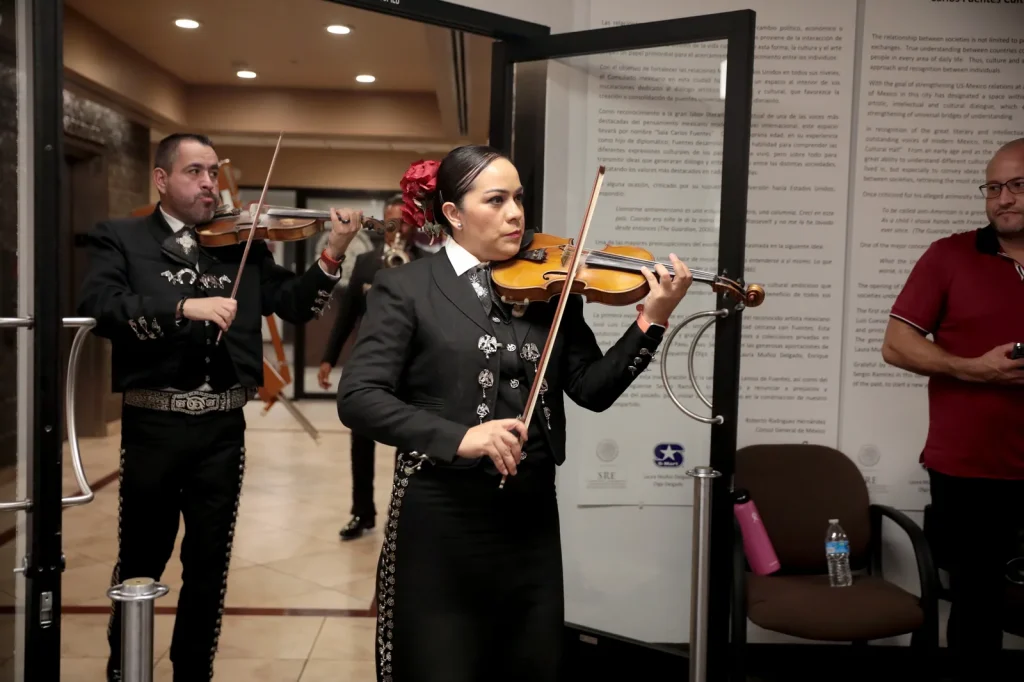
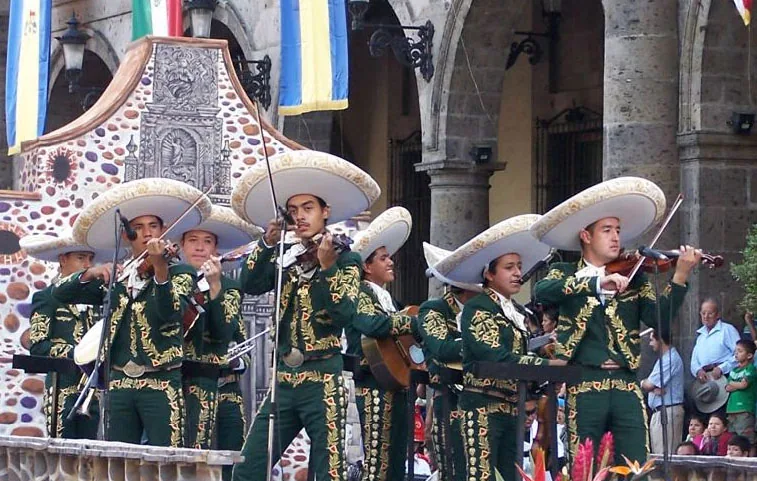
Mariachi performance is inseparable from social ritual and festive event. Groups are engaged for baptisms, first communions, quinceañeras (15th birthday celebrations), weddings, funerals, and civic occasions — performing a tu gusto (to the client’s taste) from the full repertoire at request. The distinctive costume — adapted from the formal traje de charro (horseman’s suit) of Jalisco’s landed gentry — features silver-buttoned suits, wide-brimmed sombrero, and decorative ties, functioning as a visual signal of professional identity. The serenata tradition — playing outside a window at dawn for a birthday — remains a living social practice in Mexican communities worldwide.
Transmission continues primarily through ear and apprenticeship: young musicians learn by watching and imitating experienced performers in rehearsal and at live events, absorbing the repertoire and the improvisational conventions of the ensemble. Formal academic programs have developed alongside this traditional transmission — UCLA established the first university Mariachi student group in 1961, and annual festivals in Guadalajara, Tucson (founded 1982), and Las Vegas (founded 1991) now function as training and performance centers. For how mariachi fits within the full UNESCO Representative List, the UNESCO intangible cultural heritage examples article provides context across the broader inscription landscape.
For official documentation including the full nomination file and Committee decision, ich.unesco.org/en/RL/mariachi-string-music-song-and-trumpet-00575 is the authoritative source.
Frequently Asked Questions
Is Mariachi a UNESCO intangible cultural heritage?
Yes. Mariachi is inscribed on UNESCO’s Representative List of the Intangible Cultural Heritage of Humanity under the official designation “Mariachi, string music, song and trumpet” (File 00575). It was inscribed in November 2011 at the 6th session of the Intergovernmental Committee (6.COM), held in Bali, Indonesia, under Decision 6.COM 13.30. The inscription recognized mariachi as a living musical tradition of Mexico transmitted primarily through ear and community performance.
When was Mariachi added to the UNESCO list?
Mariachi was inscribed on UNESCO’s Representative List of the Intangible Cultural Heritage of Humanity in November 2011, at the 6th session of the Intergovernmental Committee (6.COM) held in Bali, Indonesia. The decision reference is 6.COM 13.30, and the element is registered under File 00575. Mexico submitted the nomination recognizing mariachi as a performing art and social practice spanning oral traditions, performing arts, and social and festive events.
What instruments are used in Mariachi?
The modern Mariachi ensemble recognized in UNESCO’s inscription includes: two trumpets (added in the 1930s through jazz and Cuban influences), four to eight violins, a Mexican vihuela (five-string high-pitched guitar with a convex back), a guitarrón (large fretless six-string acoustic bass guitar), a standard guitar, and occasionally a Mexican folk harp. The vihuela and guitarrón are the instruments most specific to mariachi and are central to its distinctive sound; the harp is now more associated with traditional regional forms than the standard professional ensemble.
Where did Mariachi originate?
Mariachi originated in the western Mexican state of Jalisco, particularly in the town of Cocula — recognized as the “World Cradle of Mariachi” (Cuna Mundial del Mariachi). The genre evolved from the son jalisciense, an 18th-century rural musical style performed at haciendas and ranches in the region covering Jalisco, Colima, Nayarit, Zacatecas, Aguascalientes, Michoacán, and Guanajuato. Mariachi transformed into an urban popular form during the late 19th and early 20th centuries as musicians migrated to Guadalajara and Mexico City, and was subsequently promoted nationally by the Mexican government via radio and cinema.
What is the origin of the word “mariachi”?
The etymology of mariachi is disputed. The most popular theory — that it derives from the French word mariage (marriage), because of the music’s association with weddings — has been effectively refuted: a Catholic priest’s letter from 1852 already used the word “mariachi,” and the French intervention in Mexico did not begin until 1862. Alternative theories propose an origin from an indigenous Nahuatl or Coca word for the wood used for the dance platform (tarima), or from a local image called “María H.” The question remains unresolved, but the 1852 document establishes that the word predates French influence on Mexico.