Kumbh Mela UNESCO Intangible Cultural Heritage: 2017 Inscription, Four Sacred Sites, and the Largest Pilgrimage on Earth
The Kumbh Mela was inscribed on UNESCO’s Representative List of the Intangible Cultural Heritage of Humanity in December 2017, at the 12th session of the Intergovernmental Committee for the Safeguarding of the Intangible Cultural Heritage (12.COM), held in Jeju, South Korea. The inscription was approved under Decision 12.COM 11.b.12 and assigned UNESCO File No. 01258. India is the sole nominating country. UNESCO described the Kumbh Mela as “the largest peaceful congregation of pilgrims on Earth” — a designation held by no other inscribed element. The 2025 Maha Kumbh Mela at Prayagraj drew an official attendance of more than 660 million pilgrims across 45 days, making it the largest human gathering in recorded history.
- The Kumbh Mela was inscribed in December 2017 at the 12th Committee session (12.COM) in Jeju, South Korea, under Decision 12.COM 11.b.12, as File No. 01258.
- UNESCO designated it “the largest peaceful congregation of pilgrims on Earth” — the only inscribed ICH element described in these terms.
- The Kumbh rotates among four sacred river sites — Prayagraj, Haridwar, Nashik, and Ujjain — on a cycle tied to Jupiter’s 12-year orbit through the zodiac and the positions of the Sun and Moon.
- The Maha Kumbh Mela — held at Prayagraj only once every 144 years, after 12 consecutive Purna Kumbhs — drew over 660 million pilgrims in 2025, the largest human gathering in recorded history.
- UNESCO’s inscription covers a synthesis of astronomy, astrology, ritualistic bathing, and the akhara tradition — the ancient orders of ascetics organized by Adi Shankaracharya in the 8th century CE that remain the institutional core of the Kumbh.
The 2017 UNESCO Inscription: What India’s Nomination Covers
The 12.COM session at Jeju in December 2017 inscribed the Kumbh Mela on the Representative List under Decision 12.COM 11.b.12. The inscription is notable for its breadth: UNESCO recognized the Kumbh not as a single ritual but as a multi-domain living heritage encompassing astronomical knowledge, spiritual practice, social organization, and community transmission. The designation “largest peaceful congregation of pilgrims on Earth” is embedded in the official UNESCO documentation and distinguishes the Kumbh from every other element on the Representative List by scale.
What the Inscription Covers: Astronomy, Ritual Bathing, and Akharas
UNESCO’s inscription for the Kumbh Mela encompasses five interlocking dimensions:
- Astronomical and astrological knowledge: The dates of each Kumbh Mela are not set by calendar convention but calculated from the positions of Jupiter (Bṛhaspati), the Sun (Surya), and the Moon (Chandra). The tradition preserves and transmits a living body of astronomical and astrological expertise held by the priestly communities who determine the sacred dates — a form of knowledge with documented continuity stretching back over a millennium.
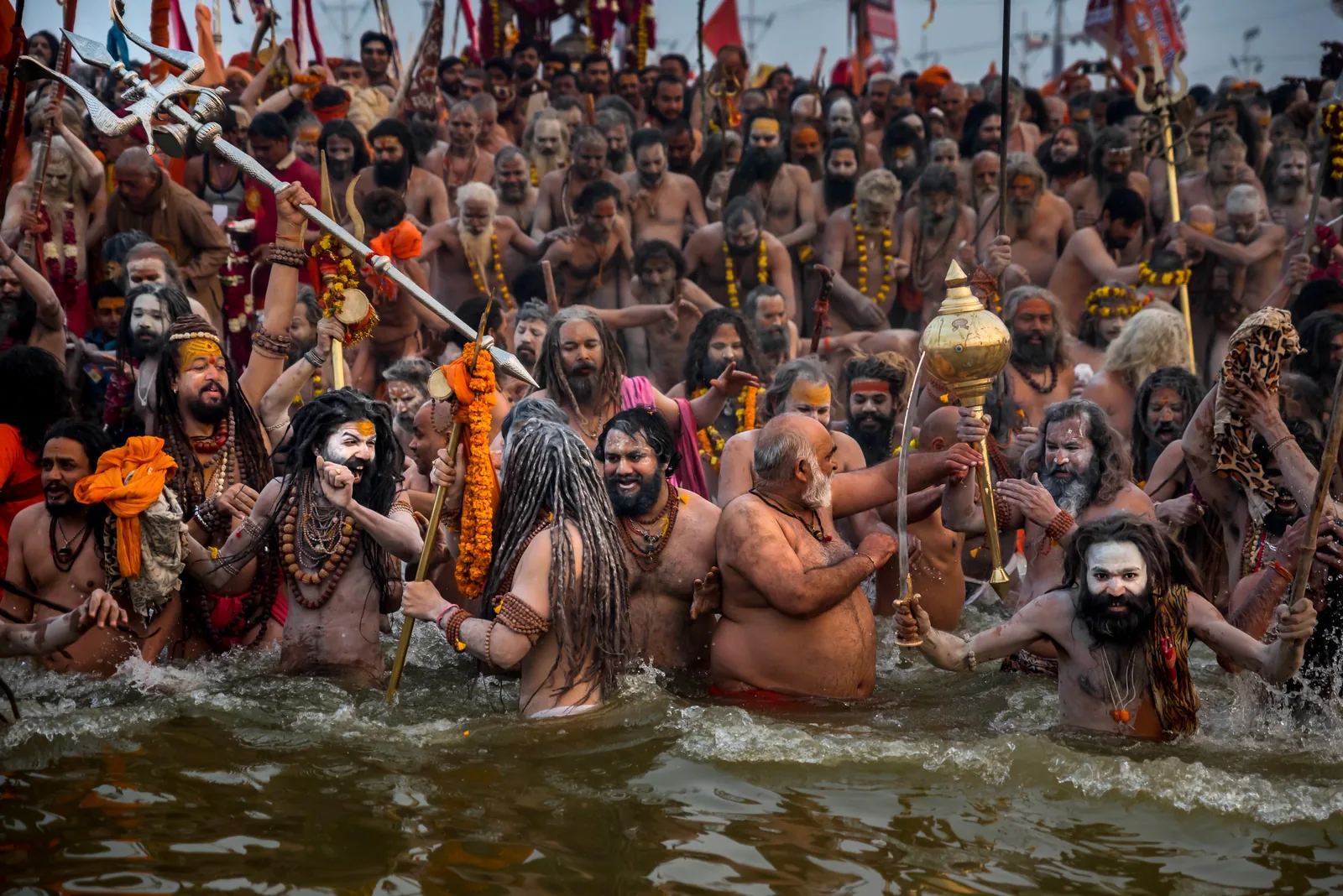
- Ritual bathing (Shahi Snan): The central act of the Kumbh is snan — ritual immersion in the sacred river at the site. On specific astrologically determined dates (shahi snans or “royal bathing” days), millions of pilgrims enter the water simultaneously. The spiritual purpose is purification and liberation from the cycle of death and rebirth. The practice is understood as drawing on the mythological presence of the amrita (nectar of immortality) believed to have fallen at each of the four sites during the Samudra Manthan (cosmic churning of the ocean).
- The akhara tradition: The akharas are the ancient orders of Hindu ascetics and sadhus that have been the institutional organizers of the Kumbh since at least the 8th century CE, when Adi Shankaracharya is credited with organizing Hindu monks into formal orders. There are currently 13 recognized akharas. Their procession to the bathing ghats on shahi snan days — the shobha yatra (royal procession) — is the defining ceremonial event of each Kumbh and establishes the sequence in which different monastic orders enter the river.
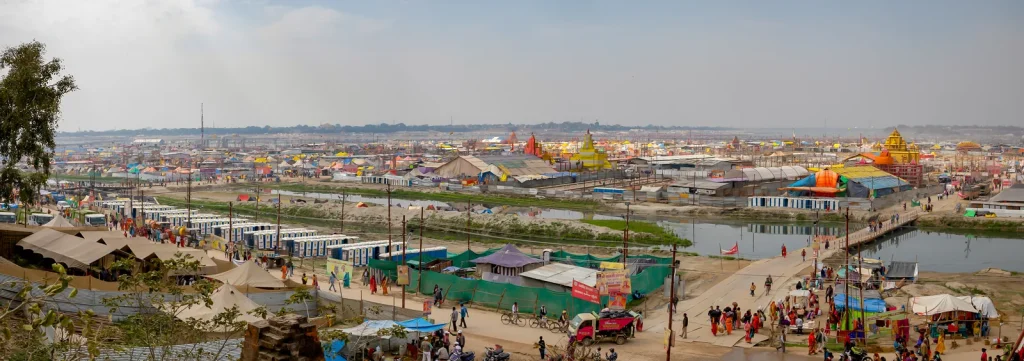
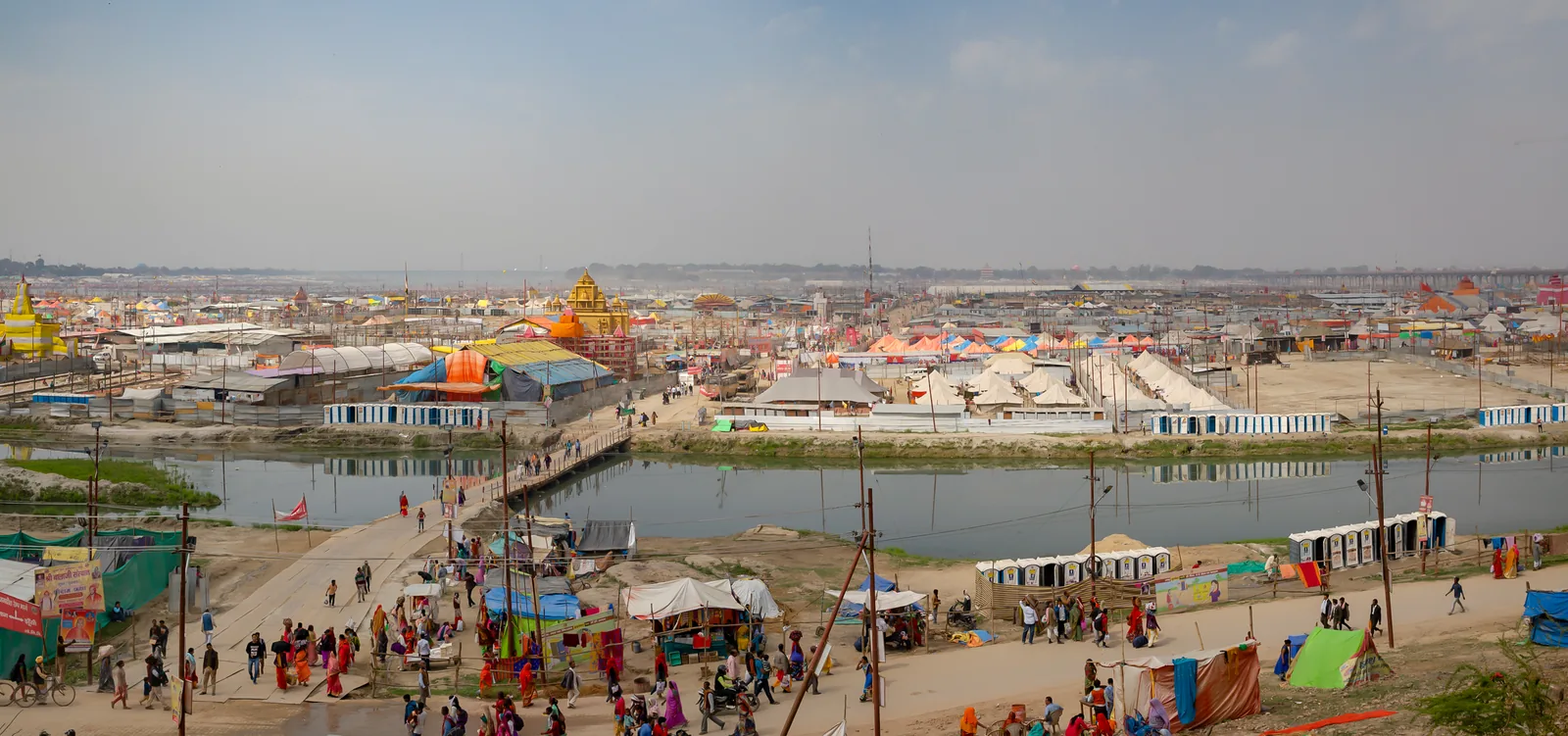
- Social practices and festive culture: The Kumbh creates a temporary city — at Prayagraj the tent city at the 2025 Maha Kumbh covered approximately 10,000 hectares. This temporary urban infrastructure hosts not only pilgrims but merchants, musicians, storytellers, and the full spectrum of popular religious culture. UNESCO recognized these social dimensions as inseparable from the ritual core.
- Community transmission: The Kumbh’s astronomical and ritual knowledge is transmitted through the guru-shishya (teacher-student) relationship within ashrams and akharas, supplemented by ancient manuscripts and oral traditions. UNESCO’s inscription explicitly identifies this informal transmission network as the primary mechanism through which Kumbh knowledge is reproduced across generations.
Participants: Pilgrims, Sadhus, and Kalpavasis
The 2017 inscription explicitly identified the communities constituting the Kumbh: ascetics, saints, sadhus, aspirants (kalpavasis), and visitors across all castes, creeds, and genders. The kalpavasis — a particularly dedicated category of pilgrims who camp at the Kumbh site for the entire duration, observing strict spiritual discipline — represent the living core of the tradition. The Kumbh is thus protected not as elite religious practice but as a mass community participation event, in keeping with the UNESCO 2003 Convention’s emphasis on community-based, living heritage.
Four Sacred Sites: The Jupiter Cycle and Types of Kumbh Mela
The Kumbh Mela is not a single fixed event but a system of pilgrimages rotating among four sacred river sites across India, each determined by astronomical conditions that will not recur for 12 years at that location. This rotational system — and the astronomical precision underlying it — is what UNESCO recognized as one of the tradition’s most distinctive dimensions.
The Four Sites and Their Sacred Rivers
Each of the four Kumbh sites is located at a sacred river confluence believed to have received drops of the amrita during the Samudra Manthan:
- Prayagraj (Uttar Pradesh): The confluence of the Ganga, Yamuna, and the mythological Saraswati rivers — Triveni Sangam — is considered the most sacred of the four sites. The Kumbh at Prayagraj is the largest by attendance.
- Haridwar (Uttarakhand): On the Ganga as it descends from the Himalayas into the plains. Kumbh held when Jupiter enters Aquarius and the Sun enters Aries.
- Nashik (Maharashtra): On the Godavari River. Kumbh held when Jupiter enters Leo.
- Ujjain (Madhya Pradesh): On the Kshipra River. Kumbh held when Jupiter enters Leo and the Sun enters Aries — in the same astronomical window as Nashik, meaning the two are often held in the same or adjacent years.
Ardh, Purna, and Maha Kumbh: The 144-Year Cycle
The Kumbh system operates on multiple time scales:
- Ardh Kumbh Mela (“half Kumbh”) — held at Prayagraj and Haridwar approximately every 6 years, between the full Purna Kumbh cycles at those sites.
- Purna Kumbh Mela (“full Kumbh”) — held at each of the four sites once every 12 years, when Jupiter completes its full cycle through the zodiac and returns to the requisite position for that site.
- Maha Kumbh Mela (“great Kumbh”) — held exclusively at Prayagraj once every 144 years, after 12 consecutive Purna Kumbh cycles. The astrological alignment required for the Maha Kumbh occurs only once in 144 years, making it the rarest and most sacred configuration.
The 2025 Maha Kumbh Mela at Prayagraj (January 13 – February 26, 2025) was therefore a 144-year event — the first Maha Kumbh since 1882. Official Indian government figures documented more than 660 million pilgrims over 45 days, with a peak single-day attendance of approximately 80 million on January 29. The scale surpasses any other gathering in recorded human history. The previous Purna Kumbh at Prayagraj in 2019 had drawn approximately 240 million pilgrims; the 2013 Maha Kumbh (termed as such in earlier usage) drew approximately 120 million. The 2025 event thus more than quintupled the 2013 figure, reflecting both the 144-year significance and India’s population growth.
For the official UNESCO documentation including the full nomination file, periodic reports, and Committee decisions, ich.unesco.org/en/RL/kumbh-mela-01258 is the authoritative source. For context on the broader ICH system that places the Kumbh Mela alongside other landmark inscriptions such as falconry (24 countries) and Nowruz (12 countries), the UNESCO intangible cultural heritage overview traces the full system from the 2003 Convention to 2025.
Frequently Asked Questions
When was Kumbh Mela inscribed on UNESCO’s intangible cultural heritage list?
The Kumbh Mela was inscribed in December 2017 at the 12th session of the Intergovernmental Committee for the Safeguarding of the Intangible Cultural Heritage (12.COM), held in Jeju, South Korea. The inscription was approved under Decision 12.COM 11.b.12 and assigned UNESCO File No. 01258 on the Representative List of the Intangible Cultural Heritage of Humanity.
What does UNESCO’s Kumbh Mela inscription cover?
UNESCO’s inscription covers five dimensions: astronomical and astrological knowledge (the calculation of sacred dates from Jupiter, Sun, and Moon positions); ritual bathing (shahi snan, immersion in sacred rivers on astrologically determined dates); the akhara tradition (the 13 recognized orders of ascetics organized since the 8th century CE); social and festive culture (the temporary city infrastructure); and community transmission through the guru-shishya relationship within ashrams and akharas.
What is the difference between Ardh Kumbh, Purna Kumbh, and Maha Kumbh Mela?
The Ardh Kumbh Mela (“half Kumbh”) is held at Prayagraj and Haridwar approximately every 6 years. The Purna Kumbh Mela (“full Kumbh”) is held at each of the four sites (Prayagraj, Haridwar, Nashik, Ujjain) once every 12 years, tied to Jupiter’s 12-year orbit. The Maha Kumbh Mela (“great Kumbh”) is held exclusively at Prayagraj once every 144 years — after 12 consecutive Purna Kumbh cycles — and represents the rarest and most sacred configuration.
How many people attended the 2025 Maha Kumbh Mela?
Official Indian government figures documented more than 660 million pilgrims at the 2025 Maha Kumbh Mela at Prayagraj (January 13 – February 26, 2025) over 45 days. Peak single-day attendance was approximately 80 million on January 29. This is the largest human gathering in recorded history. The 2025 event was a 144-year occurrence — the first Maha Kumbh since 1882.
Why is Prayagraj the most important Kumbh Mela site?
Prayagraj holds the Triveni Sangam — the sacred confluence of the Ganga, Yamuna, and the mythological Saraswati rivers — considered the most sacred of the four Kumbh sites. It is the only location that hosts the Maha Kumbh Mela (the 144-year cycle), in addition to regular Purna Kumbh (12 years) and Ardh Kumbh (6 years) events. The combination of the triple river confluence and the Maha Kumbh cycle makes it the highest-attendance site by a large margin.