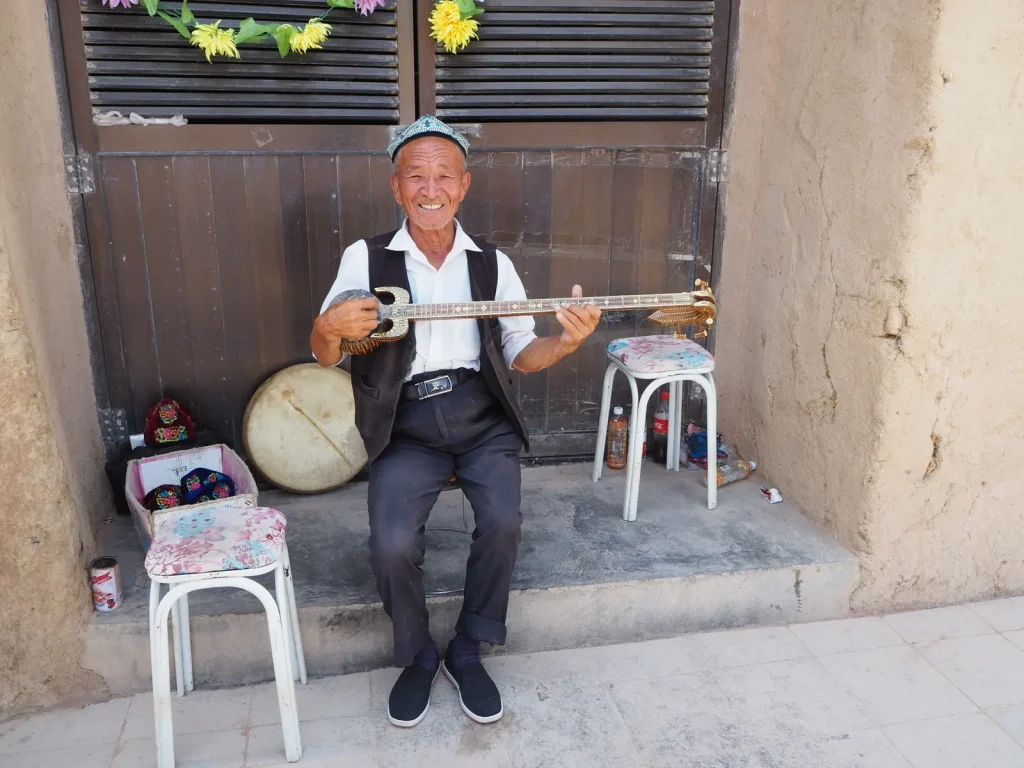
Uyghur Muqam of Xinjiang: UNESCO Intangible Cultural Heritage (File 00109) — The Twelve Suites, History, and Tradition
The Uyghur Muqam of Xinjiang — a comprehensive performing art combining classical music, song, poetry, dance, and folk entertainment, organized into twelve major suites performed by the Uyghur people of China’s Xinjiang region — was proclaimed one of UNESCO’s Masterpieces of the Oral and Intangible Heritage of Humanity in 2005 (3rd Proclamation) and formally inscribed on the Representative List of the Intangible Cultural Heritage of Humanity in 2008 (File 00109, 3.COM). Rooted in the oasis cities of western China’s Tarim Basin along the ancient Silk Road routes, the Uyghur Muqam represents one of the world’s most elaborate classical music systems: the On Ikki Muqam (Twelve Muqam) cycle alone comprises more than 300 pieces requiring approximately 24 hours to perform in full, structuring Uyghur music, dance, and poetic tradition into an integrated artistic system whose origins are traced to the 16th-century court of the Yarkent Khanate.
- The Uyghur Muqam of Xinjiang is inscribed on UNESCO’s Representative List as File 00109, proclaimed a Masterpiece in 2005 and formally inscribed in 2008 (3.COM) — one of the 43 elements inscribed from the 2005 Masterpiece proclamation batch transferred to the Representative List.
- The tradition is organized around four regional styles — Twelve Muqam, Dolan Muqam, Turpan Muqam, and Hami Muqam — with the On Ikki Muqam (Twelve Muqam) of the western Tarim Basin considered the most fully developed form.
- The Twelve Muqam cycle consists of 12 named suites (Rak, Chebbiyat, Sëgah, Chahargah, Penjigah, Öz’hal, Ejem, Oshaq, Bayat, Nawa, Mushawrek, and Iraq), each structured in three main sections: naghma, dastan, and mashrap.
- Amannissa Khan — a consort of the Yarkent Khanate (1526–1560) — is credited with collecting and systematizing the Twelve Muqam in its classical form, drawing on the indigenous musical traditions of the Tian Shan mountain region.
- UNESCO’s inscription noted that the Muqam’s transmission — traditionally through community meshrep (festive gatherings) and folk artist apprenticeship — was under threat from declining youth participation and the dominance of contemporary entertainment forms.
Uyghur Muqam: Origins Along the Silk Road and UNESCO Inscription
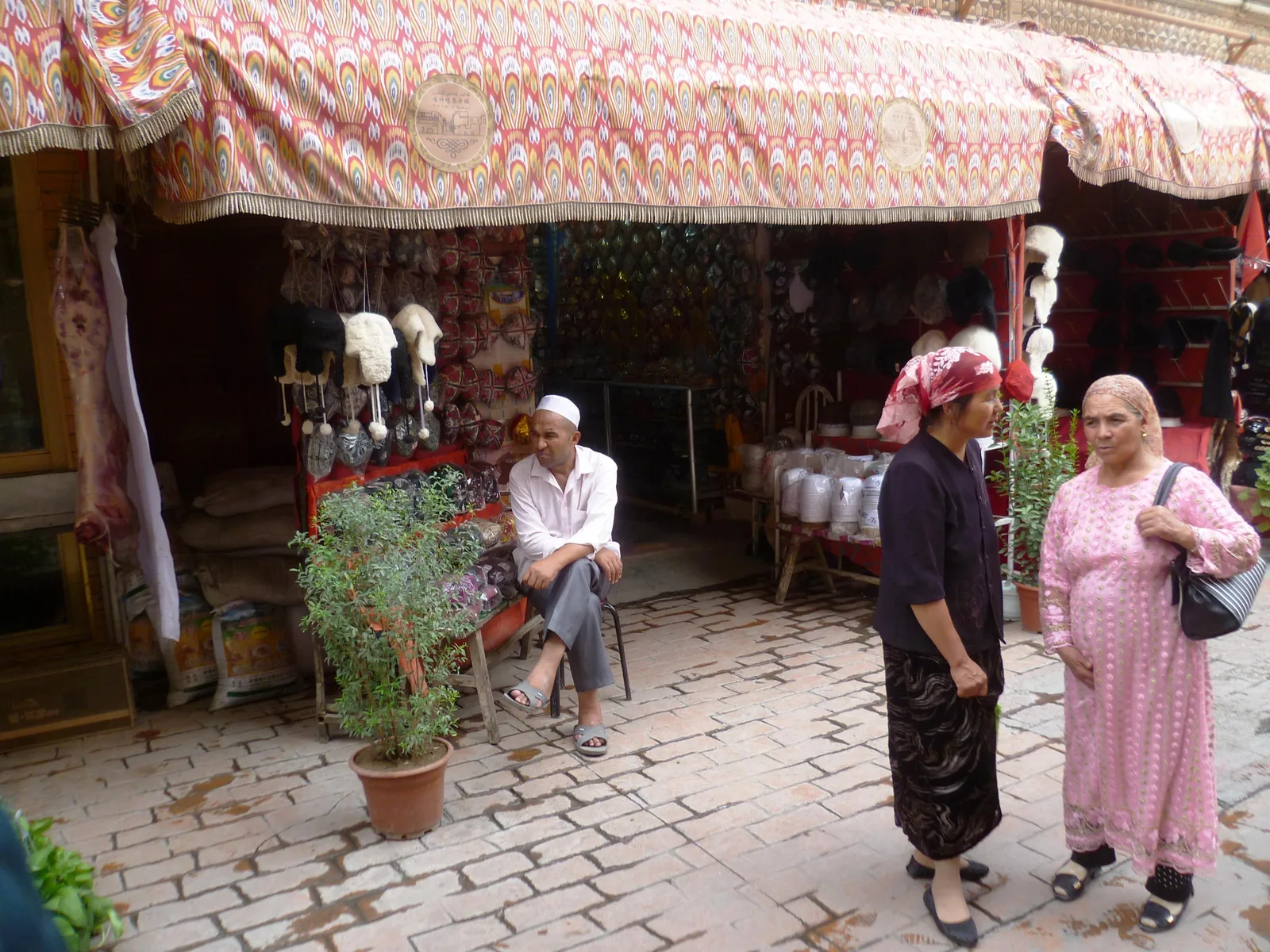
The Uyghur Muqam developed in the oasis cities of Xinjiang’s Tarim Basin — Kashgar, Hotan, Kucha, Aksu, and the neighboring regions — along the Central Asian sections of the ancient Silk Road. The word muqam (also spelled maqam in Arabic and Turkish contexts) designates both a melodic mode and the extended compositions built upon it; in Uyghur musical practice, the term encompasses the full suite form that combines instrumental prelude, classical song, epic narrative, and dance music into a unified performance cycle. Scholars have traced elements of the tradition to the Da Qu (“Great Western Region Melody”) of the Han (206 BCE–220 CE) and Tang (618–907 CE) dynasties, and to the Arabic maqam modal systems that traveled across Eurasia through centuries of Silk Road cultural exchange — making the Uyghur Muqam a synthesis of indigenous Tian Shan musical traditions and the broader Central Asian and Middle Eastern classical music heritage.
The decisive systematization of the tradition is attributed to Amannissa Khan, a consort of Said Khan of the Yarkent Khanate (c. 1526–1560) in western Xinjiang. Amannissa Khan is credited with commissioning the collection and arrangement of the Twelve Muqam in their classical form, drawing on the indigenous folk and ceremonial music of the region and reshaping the existing repertoire toward a more refined and systematic art. Her role in the tradition’s codification is commemorated in Uyghur cultural memory: she is regarded as the mother of the Twelve Muqam, and the 16th-century Yarkent court is considered the tradition’s classical era. The four distinct regional Muqam styles documented in UNESCO’s inscription reflect the geographic diversity of Uyghur musical culture across Xinjiang:
- Twelve Muqam (On Ikki Muqam): The most elaborated system, associated with the Kashgar, Hotan, and Aksu oases of the western Tarim Basin. It is the form most extensively documented in preservation projects.
- Dolan Muqam: From the Dolan Uyghur communities near Makit and Awat in southern Xinjiang, characterized by a rawer, more percussive performance style.
- Turpan Muqam: The tradition of the Turpan (Turfan) oasis in eastern Xinjiang, reflecting that region’s distinctive historical and cultural position at the eastern end of the Silk Road trade routes.
- Hami Muqam: From the Kumul (Hami) region at Xinjiang’s eastern gateway, with its own local melodic and formal character.
In modern history, the critical moment for the tradition’s preservation came in the 1950s, when the musician Turdi Akhun performed the complete Twelve Muqam cycle for Chinese music scholars and ethnomusicologists, producing the recordings and transcriptions that became the basis of the first systematic notation. The first published collection appeared in 1960. UNESCO proclaimed the Uyghur Muqam of Xinjiang a Masterpiece of Oral and Intangible Heritage in November 2005 — the third and final Masterpiece proclamation cycle before the 2003 Convention came into full effect — and formally inscribed it on the Representative List in 2008 (File 00109, 3.COM). For how the Uyghur Muqam fits within China’s full UNESCO ICH portfolio of over 40 inscriptions, the UNESCO intangible cultural heritage China list provides the full inventory. The ancestral operatic tradition that also received UNESCO recognition in China’s 2001 Masterpiece proclamation is covered in the Kunqu opera article.
The Twelve Muqam: Structure, Performance Practice, and Transmission
The On Ikki Muqam (Twelve Muqam) is organized into twelve named suites, each bearing the name of its modal foundation: Rak, Chebbiyat, Sëgah, Chahargah, Penjigah, Öz’hal, Ejem, Oshaq, Bayat, Nawa, Mushawrek, and Iraq. Each suite follows a consistent three-part architecture:
- Naghma (melodic suite): the opening section — beginning with a free-rhythm instrumental introduction (mushkilat) establishing the modal character, followed by metrically organized pieces of increasing rhythmic complexity
- Dastan (epic narrative section): longer vocal compositions with narrative content, drawing on classical Uyghur poetry and epic tradition
- Mashrap (banquet and dance section): the closing section of lively dance songs and entertainment, associated with the community gathering (meshrep) context in which the Muqam is performed
Within these three main sections, individual compositions are further organized into sub-forms — teze, nuskha, jula, senem, peshru, and tekit — each with characteristic tempos, rhythmic patterns, and formal functions. A single Muqam suite contains approximately 20–30 individual pieces requiring around 2 hours to perform; the complete Twelve Muqam cycle, performed in sequence, takes approximately 24 hours.
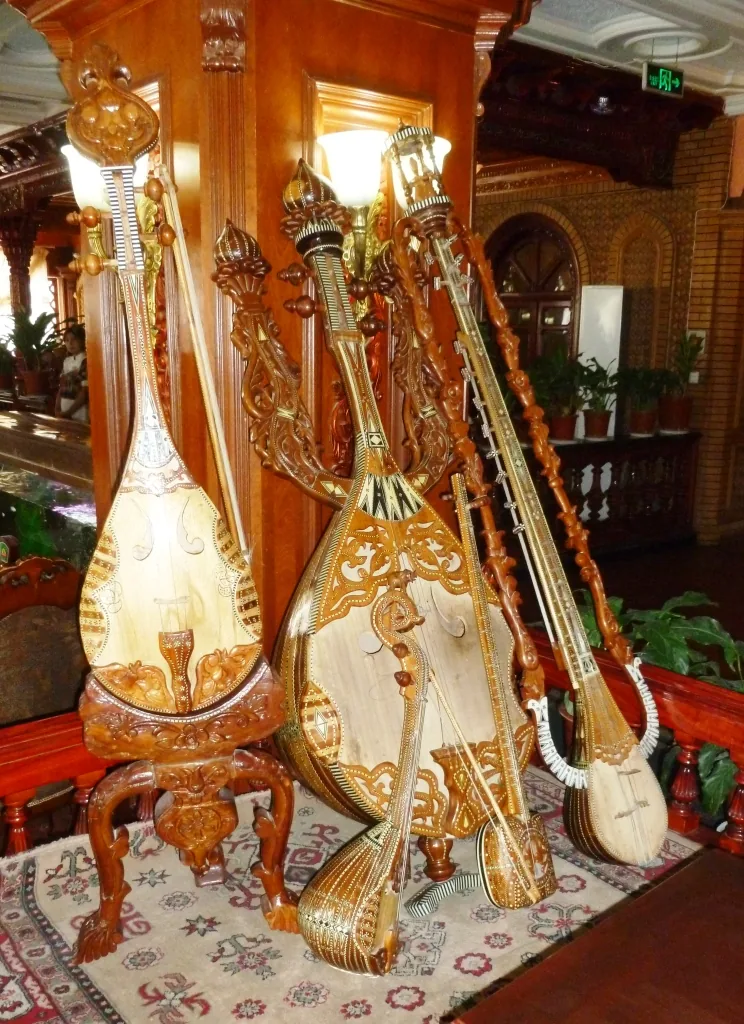
The Uyghur Muqam is performed by an ensemble combining bowed and plucked string instruments with percussion. The principal instruments include the dutar (a two-string long-neck lute with a pear-shaped body), the rawap (a plucked spike instrument with a skin soundboard), the tanbur (a long-neck fretted lute), the sato (a bowed version of the tanbur), and the qalun (a hammered dulcimer-type instrument); percussion is provided by the doira (frame drum) and naqara (small kettledrums). The vocalist — performing from the classical Uyghur poetic repertoire including the works of Babur, Nawai, and anonymous folk poets — is accompanied by this full ensemble in the formal performance context.
The social institution through which Uyghur Muqam has been transmitted across generations is the meshrep — a communal gathering combining music performance, dance, storytelling, and entertainment that serves as the primary context for informal learning and community cultural practice. Young musicians traditionally absorbed the repertoire by attending meshrep events, observing master musicians, and gradually participating in performance. UNESCO’s inscription noted that this transmission chain was under pressure: declining participation of youth in meshrep culture, the displacement of Muqam by contemporary popular music, and the increasing scarcity of trained master musicians had created conditions of endangerment. The Chinese government launched a state preservation project from 2004 to 2008, involving more than 7,000 performers in documentation seminars, research projects, and institutional recordings — the most comprehensive preservation effort in the tradition’s documented history.
For official documentation including the full nomination file and 3.COM Committee decision, ich.unesco.org/en/RL/uyghur-muqam-of-xinjiang-00109 is the authoritative source.
Frequently Asked Questions
Is Uyghur Muqam a UNESCO intangible cultural heritage?
Yes. The Uyghur Muqam of Xinjiang is inscribed on UNESCO’s Representative List of the Intangible Cultural Heritage of Humanity under File 00109. It was proclaimed one of UNESCO’s Masterpieces of the Oral and Intangible Heritage of Humanity in 2005 (the 3rd and final Masterpiece proclamation batch) and formally inscribed on the Representative List in 2008 (3.COM) when all Masterpieces were transferred under the 2003 Convention framework. The inscription recognized the Uyghur Muqam as a heritage of China’s Uyghur communities in Xinjiang.
What are the four types of Uyghur Muqam?
UNESCO’s inscription documents four regional Uyghur Muqam styles: the Twelve Muqam (On Ikki Muqam) of the western Tarim Basin (Kashgar, Hotan, Aksu regions) — the most fully developed form; the Dolan Muqam of communities near Makit and Awat; the Turpan Muqam of the Turfan oasis in eastern Xinjiang; and the Hami Muqam of the Kumul region at Xinjiang’s eastern gateway. Each style reflects the distinct musical culture of its oasis community.
What are the twelve suites of the Uyghur Twelve Muqam?
The twelve named suites of the On Ikki Muqam are: Rak, Chebbiyat, Sëgah, Chahargah, Penjigah, Öz’hal, Ejem, Oshaq, Bayat, Nawa, Mushawrek, and Iraq. Each suite is named for its modal foundation and contains approximately 20–30 individual compositions organized in three sections (naghma, dastan, and mashrap). The complete performance of all twelve suites takes approximately 24 hours.
Who is Amannissa Khan and why is she important for Uyghur Muqam?
Amannissa Khan was a consort of Said Khan of the Yarkent Khanate (c. 1526–1560) in western Xinjiang, credited with collecting and systematizing the Twelve Muqam in their classical form during the 16th century. She is considered the most important historical figure in the tradition’s codification — drawing on the indigenous folk and ceremonial music of the Tian Shan region to reshape the repertoire into a refined classical system. She is commemorated in Uyghur cultural memory as the mother of the Twelve Muqam, and the Yarkent court of her era is regarded as the tradition’s classical golden age.
What instruments are used in Uyghur Muqam?
The Uyghur Muqam ensemble combines bowed strings, plucked strings, and percussion. Principal instruments include: the dutar (two-string long-neck lute with pear-shaped body), the rawap (plucked spike instrument with skin soundboard), the tanbur (long-neck fretted lute), the sato (bowed version of the tanbur), and the qalun (hammered dulcimer-type zither); percussion instruments include the doira (frame drum) and naqara (small kettledrums). The vocalist performs from the classical Uyghur poetic repertoire accompanied by the full ensemble.