 Representative ListInscribed 2018
Description
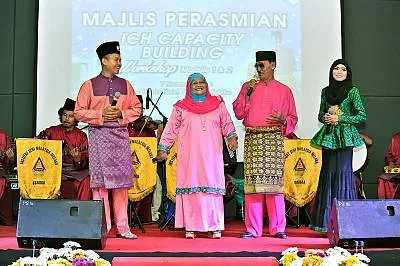
Dondang Sayang is a traditional Malay art still practised in Melaka by four communities: the Malay, Baba Nyonya, Chitty and Portuguese communities. The practice combines elements of music (violins, gongs and tambourines or the tambour), songs and chants, and features beautiful melodious strains of poetry. Also known as love ballads, the songs are used by communities to convey feelings of love and give advice on special topics such as love and kindness. During the Melaka Sultanate era in the fifteenth century, Dondang Sayang was performed at Royal Palace ceremonies and events; subsequently, the performance became widespread among the communities concerned. Based on tradition, Dondang Sayang performances are accompanied by music and sung by two singers of the opposite sex, who sing in quatrains. Typically, Dondang Sayang singers are individuals who are highly competent and skilled in poetry recitation. Dongdang Sayang performances are open to all, irrespective of age, occupation, status or religion, and the art is considered as a means of conveying positive messages and sharing feelings of love, joy and sorrow that strengthen community bonding. Performances are held on a regular basis, especially during gatherings, festivals and parties, and nowadays many cultural programmes, activities and training activities are organized for those interested in participating and improving their singing and performance skills.
Country
MalaysiaOther heritage elements in Malaysia
Representative List · Inscribed 2025PantunRepresentative List · Inscribed 2024Breakfast culture in Malaysia: dining experience in a multi-ethnic societyRepresentative List · Inscribed 2024Kebaya: knowledge, skills, traditions and practicesUrgent Safeguarding List · Inscribed 2023Mek MulungRepresentative List · Inscribed 2021SongketRepresentative List · Inscribed 2020Ong Chun/Wangchuan/Wangkang ceremony, rituals and related practices for maintaining the sustainable connection between man and the ocean
More Representative List elements
Inscribed 2020Pilgrimage to the St. Thaddeus Apostle MonasteryInscribed 2014Traditional brass and copper craft of utensil making among the Thatheras of Jandiala Guru, Punjab, IndiaInscribed 2025Ayeneh-Kari, the art of mirror-work in Persian architectureInscribed 2012Cherry festival in SefrouInscribed 2023Al-Man’ouché, an emblematic culinary practice in LebanonInscribed 2017Art of crafting and playing with Kamantcheh/Kamancha, a bowed string musical instrument
Also inscribed in 2018
- Suri Jagek (observing the sun), traditional meteorological and astronomical practice based on the observation of the sun, moon and stars in reference to the local topography
- Heritage of Dede Qorqud/Korkyt Ata/Dede Korkut, epic culture, folk tales and music
- Rūkada Nātya, traditional string puppet drama in Sri Lanka
- Pottery skills of the women of Sejnane
- Shadow play
- Horse and camel Ardhah
Data Source: UNESCO Intangible Cultural Heritage · UNESCO listing