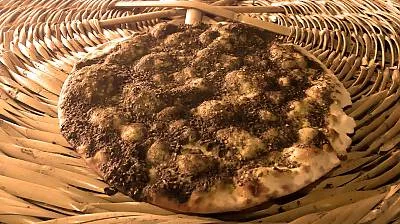
 Representative ListInscribed 2023
Description
The quintessential Lebanese breakfast, Al-Man’ouché is a flatbread prepared in homes and specialized bakeries, and enjoyed by people of all backgrounds. The dough is indented using the fingertips and topped with a mixture of thyme, sumac, toasted sesame seeds, salt and olive oil. Once cooked, a second garnish can be added, such as soft cheese (labne), tomatoes, cucumbers, olives and mint leaves. Al-Man’ouché is prepared by women for domestic consumption and by men, women or all members of the same family in small Man’ouché bakeries. While preparing the dough, the practitioners pray that it will rise, with Muslims reciting the beginning of Fatiha and Christians reciting several prayers and making the sign of the cross before letting the dough rest. The techniques of preparing Man’ouché and its toppings are usually transmitted informally from parents to children. When members of the same family participate in making al-Man’ouché, there is a division of tasks according to gender. The aroma of al-Man’ouché is a strong identifying factor that evokes traditional morning gatherings, or sobhhiyé, key moments of social interaction. The preparation of al-Man’ouché for sale in small bakeries also contributes to local economic development.
Country
LebanonMore Representative List elements
Inscribed 2021The art of embroidery in Palestine, practices, skills, knowledge and ritualsInscribed 2019Khorazm dance, LazgiInscribed 2024Tradition of Nabulsi soap making in PalestineInscribed 2020Al Aflaj, traditional irrigation network system in the UAE, oral traditions, knowledge and skills of construction, maintenance and equitable water distributionInscribed 2021Al-Qudoud al-HalabiyaInscribed 2022Crafting and playing the Oud
Also inscribed in 2023
- Traditional knowledge, methods and practices concerning olive cultivation
- Procession and celebrations of Prophet Mohammed's birthday in Sudan
- Art of Akhal-Teke horse breeding and traditions of horses' decoration
- Harees dish: know-how, skills and practices
- Ceramic arts in Uzbekistan
- Craftsmanship of mother of pearl inlay
Data Source: UNESCO Intangible Cultural Heritage · UNESCO listing