
 Representative ListInscribed 2020
Description
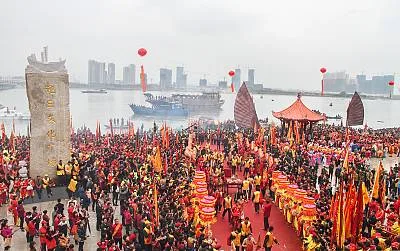
The Ong Chun ceremony and related practices are rooted in folk customs of worshipping Ong Yah, a deity believed to protect people and their lands from disasters. Developed in China’s Minnan region between the fifteenth and seventeenth centuries, the element is now centered in the coastal areas of Xiamen Bay and Quanzhou Bay, as well as in the Chinese communities in Melaka, Malaysia. Those who died at sea are considered as ‘good brothers’ who become lonely, wandering souls. The ceremony begins by people gathering at the seaside to welcome Ong Yah to temples or clan halls, while lamp poles are erected to summon ‘good brothers’ and deliver them from torment. In this way, the element has been celebrated as ‘doing good deeds’. Performances head the procession and clear a path for Ong Yah’s barge (wooden or paper-made models). These performances include gaojia and gezai opera, different dances, comprising dragon and lion dances, and puppet shows, among many others. The element evokes the historical memory of ancestors’ ocean-going, reshapes social connections when confronted with emergencies such as shipwrecks, and honours the harmony between man and the ocean. It also bears witness to the intercultural dialogue among communities.
Countries & Communities
CNMalaysiaMore Representative List elements
Inscribed 2010Pahlevani and Zoorkhanei ritualsInscribed 2023Rickshaws and rickshaw painting in DhakaInscribed 2024Myanmar traditional New Year Atā Thingyan festivalInscribed 2025Traditional knowledge and skills in making Kyrgyz, Kazakh and Karakalpak yurts (Turkic nomadic dwellings)Inscribed 2023Traditional knowledge and skills of production of the atlas and adras fabricsInscribed 2024Henna: rituals, aesthetic and social practices
Also inscribed in 2020
- Al Aflaj, traditional irrigation network system in the UAE, oral traditions, knowledge and skills of construction, maintenance and equitable water distribution
- Camel racing, a social practice and a festive heritage associated with camels
- Knowledge, know-how and practices pertaining to the production and consumption of couscous
- Handmade weaving in Upper Egypt (Sa'eed)
- Charfia fishing in the Kerkennah Islands
- Nar Bayrami, traditional pomegranate festivity and culture
Data Source: UNESCO Intangible Cultural Heritage · UNESCO listing