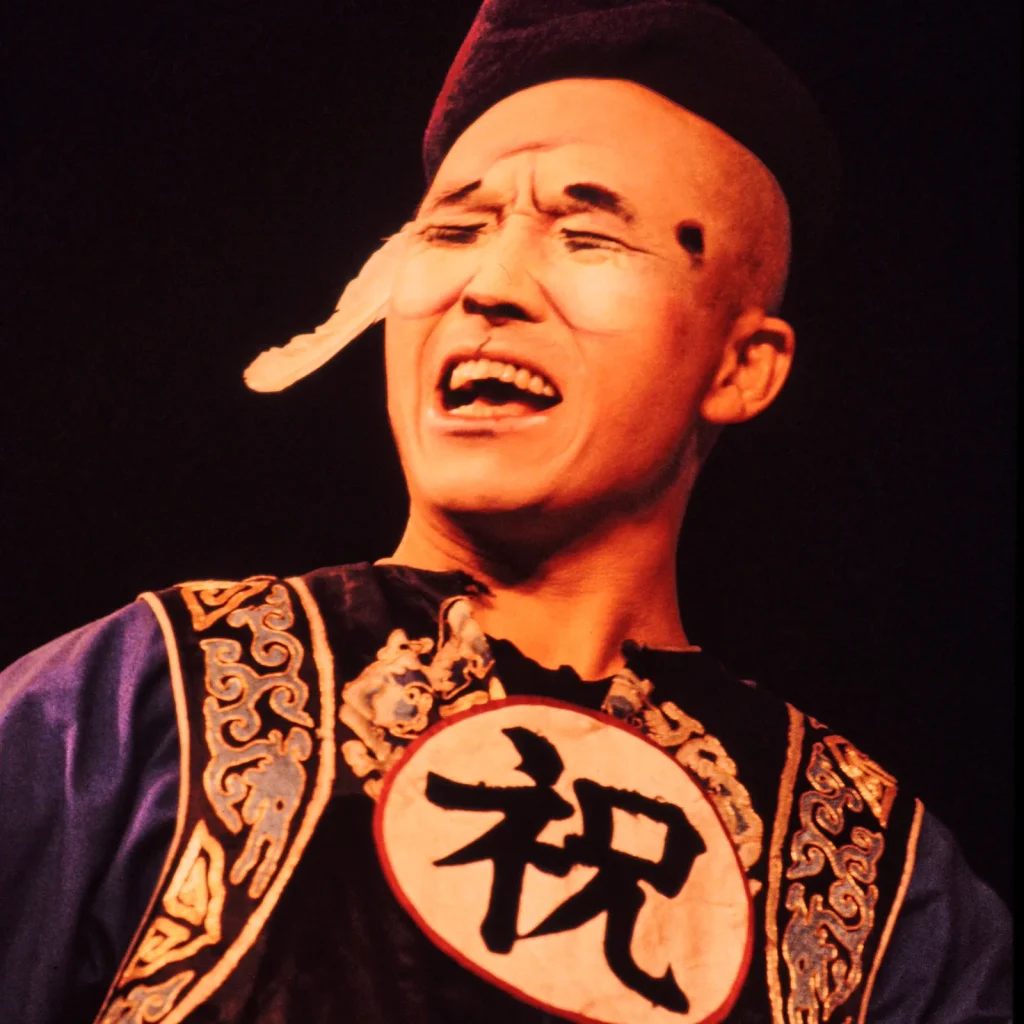
Peking Opera UNESCO Intangible Cultural Heritage: File 00418, Origins, and Performance
Peking opera (京剧, jīngjù — also called Beijing opera) is China’s most widely recognized performing art — a theatrical form combining singing, reciting, acting, and martial arts that emerged in Beijing in the 1790s and consolidated into its classical form by the mid-19th century. In 2010, UNESCO inscribed Peking opera on the Representative List of the Intangible Cultural Heritage of Humanity (File 00418) at the 5th session of the Intergovernmental Committee (5.COM), held in Nairobi, Kenya. Though it draws heavily from the earlier Kunqu opera tradition (UNESCO File 00004, inscribed 2001/2008), Peking opera developed a more dramatically intense and rhythmically dynamic style that made it China’s dominant theatrical form from the 19th century onward. Its elaborate painted-face makeup (lianpu), flamboyant costumes, and distinctive vocal techniques have made it internationally synonymous with Chinese opera.
- Peking opera was inscribed on UNESCO’s Representative List in 2010 (File 00418, 5.COM Nairobi) — China’s second ICH inscription after Kunqu opera’s 2001 Masterpiece proclamation.
- Peking opera originated in 1790 when four Anhui opera troupes arrived in Beijing to perform for Emperor Qianlong’s 80th birthday and remained to synthesize the regional xipi and erhuang music systems into the new form, considered fully formed by 1845.
- The tradition combines four performance elements: singing (chang), reciting (nian), acting (zuo), and martial arts/acrobatics (da) — organized around four major role types (Sheng, Dan, Jing, Chou).
- Peking opera’s facial makeup (lianpu) uses a color-coded symbolic system to convey character personality — red for loyalty and valor, white for cunning and treachery, black for integrity and fierceness.
- Mei Lanfang (1894–1961), the greatest performer of female roles (dan) in Peking opera history, was the first Chinese performing artist to achieve international recognition in the West, influencing Bertolt Brecht and other theater innovators.
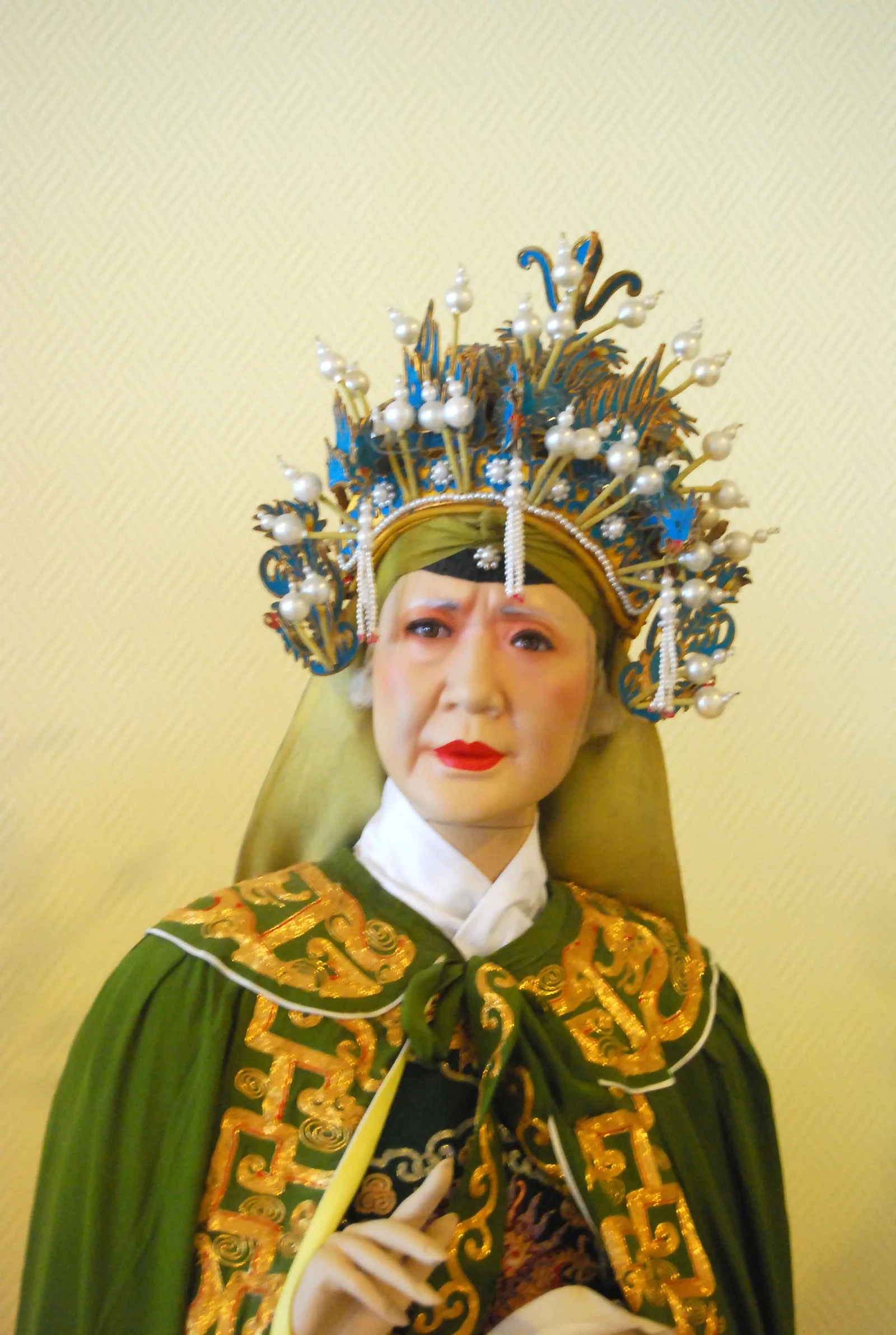
Peking Opera: Origins in the Qing Dynasty and UNESCO Inscription
Peking opera’s origin is precisely documented: in 1790, the Four Great Anhui Troupes (sì dà huì bān) arrived in Beijing to perform at the court of the Qianlong Emperor on the occasion of his 80th birthday. The four companies — Sānqìng (Three Celebrations), Sìxǐ (Four Delights), Chūntái (Spring Stage), and Héchūn (Gentle Spring) — were practitioners of Hui opera from Anhui Province, a tradition based on the xipi and erhuang musical systems. Rather than return south after the imperial performances, these troupes remained in Beijing and began performing for general audiences. Over the following decades, through interaction with Kunqu performers and musicians, Qin opera practitioners from Shaanxi, and the local Beijing musical culture, the Anhui troupes’ style evolved into a distinct new theatrical form. By approximately 1845, this synthesis had consolidated into what is now recognized as Peking opera, or jīngjù — “the opera of the capital.”
The new form deliberately departed from Kunqu’s refined, slow-paced aesthetic toward a more dramatically direct and rhythmically vigorous style. Where Kunqu was the theater of the imperial court and educated elite, Peking opera addressed a broader urban audience that responded to its heightened vocal dynamics, spectacular acrobatic sequences, and viscerally expressive painted-face makeup. The form reached its golden age in the late Qing dynasty (late 19th–early 20th centuries), when its most celebrated performers — including Tan Xinpei (1847–1917), the first Peking opera performer recorded on cylinder phonograph, and Mei Lanfang (1894–1961), the greatest practitioner of female roles and the first Chinese artist to achieve international celebrity in New York and Moscow — defined the classical repertoire and style. Mei Lanfang’s performances influenced European theater directors including Bertolt Brecht, who derived his theory of “alienation effect” (Verfremdungseffekt) partly from observing Peking opera’s symbolic, non-naturalistic performance conventions.
UNESCO’s 2010 inscription (File 00418) recognized Peking opera as an expression of the aesthetic ideal of traditional Chinese society — “a comprehensive performing art integrating music, vocal performance, mime, acrobatics and dance” whose elaborate codification of costume, makeup, movement, and vocal technique constitutes a complete semiotic system encoding social hierarchy, moral values, and cosmological concepts. The performance centers are Beijing, Tianjin, and Shanghai. Transmission occurs primarily through the classical master-student system: trainees study vocal technique, physical posture, and role-specific conventions through years of observation and imitation under a master practitioner.
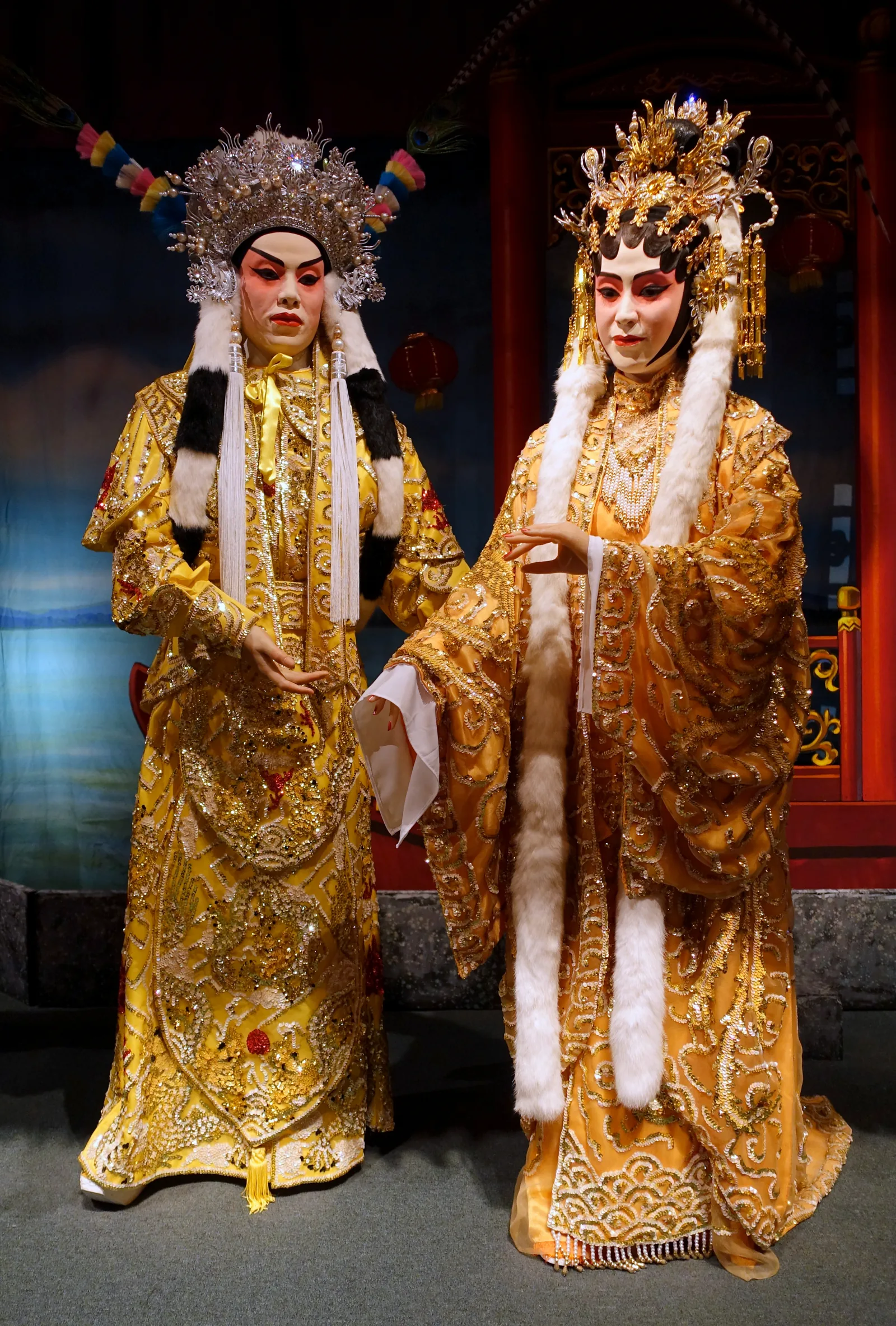
Performance Practice: Roles, Music, and Makeup
Peking opera performance integrates four arts simultaneously: chang (singing), nian (recitation/speech), zuo (acting/pantomime), and da (combat/acrobatics). The vocal styles differ between civilian plays (wenxi, accompanied primarily by string and wind instruments) and military plays (wuxi, accompanied primarily by percussion). The principal instruments are:
- The jīnghú (京胡) — a high-pitched two-string fiddle that is the leading instrument of Peking opera, providing the melody and setting the pitch for the singer’s voice
- The yuèqín (月琴) — a round-bodied four-string plucked lute providing harmonic support
- The erhu (二胡) — a lower-pitched two-string fiddle providing melodic counterpoint
- The bāngú (板鼓) — a small drum and wooden clapper combination that controls the tempo and coordinates the ensemble
- Daluo, xiaoluo, and nao gongs of various sizes that mark transitions and highlight dramatic moments
The role system (hángdāng) organizes all characters into four primary types, each with sub-types defining specific vocal and physical styles:
- Sheng (生): Male roles — including lǎosheng (bearded older gentlemen/officials), wúshēng (martial heroes), and xiǎoshēng (young romantic scholars)
- Dan (旦): Female roles — including zhèngdàn (virtuous older women), huādàn (vivacious young women), and wǔdàn (martial female heroines)
- Jing (净): Painted-face roles — generals, supernatural beings, rebels, and figures of intense passion — whose elaborate face-painting (liǎnpǔ) encodes character in color: red for loyal valor, white for cunning treachery, black for fierce integrity, blue for ferocity, yellow for calculating intelligence
- Chou (丑): Comic roles — clowns, servants, and minor characters — identifiable by a small white patch around the nose
Stage space in Peking opera is essentially bare; a table and chairs signal palace or military setting through their position. A single prop — a riding crop, a paddle, a lantern — stands in symbolically for its referent. Costumes follow the styles of the Ming and Qing dynasties, using silk embroidery and structured headdresses that signal rank and role type. Performers manipulate shuǐxiù (water sleeves — long extensions of white silk attached to costume cuffs) in a codified vocabulary of hundreds of movements that express emotional states. These formal conventions — which deliberately reject theatrical naturalism in favor of stylized, symbolic representation — were precisely what fascinated Brecht and other 20th-century Western theater reformers seeking an alternative to the psychological realism of the Stanislavski tradition.
For full documentation including the nomination file and 5.COM Committee decision, ich.unesco.org/en/RL/peking-opera-00418 is the authoritative source. For how Peking opera fits within China’s complete UNESCO ICH portfolio of 44 inscriptions, see the UNESCO intangible cultural heritage China list. For the ancestral tradition from which Peking opera evolved, see Kunqu opera UNESCO ICH.
Frequently Asked Questions
Is Peking opera a UNESCO intangible cultural heritage?
Yes. Peking opera (京剧, jīngjù) is inscribed on UNESCO’s Representative List of the Intangible Cultural Heritage of Humanity under File 00418. It was inscribed in 2010 at the 5th session of the Intergovernmental Committee (5.COM), held in Nairobi, Kenya. The inscription recognized Peking opera as a comprehensive performing art integrating singing, reciting, acting, and martial arts that is central to China’s cultural heritage.
When and where did Peking opera originate?
Peking opera originated in Beijing in 1790, when the Four Great Anhui Troupes arrived to perform at the court of the Qianlong Emperor for his 80th birthday. These troupes, practitioners of Hui opera from Anhui Province, remained in Beijing and gradually synthesized their xipi and erhuang musical systems with Kunqu elements and other regional styles. By approximately 1845, the distinctive synthesis was considered fully formed as the new theatrical tradition called jīngjù (opera of the capital).
What are the four role types in Peking opera?
Peking opera organizes all characters into four primary role types: Sheng (male roles — scholars, officials, generals), Dan (female roles — young women, older women, martial heroines), Jing (painted-face roles — generals, supernatural beings, figures of intense passion, with elaborate face-painting that color-codes character), and Chou (comic roles — clowns, servants, minor characters, identifiable by a small white patch around the nose).
What do the colors in Peking opera makeup mean?
Peking opera’s facial makeup (liǎnpǔ) uses a color-coded symbolic system for the Jing (painted-face) roles: red represents loyalty, courage, and valor (e.g., Guan Yu, the general-deity); white represents cunning, treachery, or cruelty (e.g., the villain Cao Cao); black represents fierce integrity, boldness, and righteousness (e.g., Judge Bao); blue represents ferocity and boldness; yellow represents calculating intelligence. Sheng and Dan role-types wear no face paint, only refined cosmetic makeup.
Who was Mei Lanfang and why is he significant in Peking opera?
Mei Lanfang (1894–1961) was the most celebrated practitioner of dan (female) roles in Peking opera history and the first Chinese performing artist to achieve major international recognition in the West. He performed in New York in 1930 and Moscow in 1935, where his stylized, symbolic performance conventions influenced Bertolt Brecht’s development of his “alienation effect” (Verfremdungseffekt) — the theatrical theory that actors should demonstrate rather than psychologically inhabit their characters. Mei Lanfang’s legacy remains central to Peking opera training and aesthetics.