Jemaa el-Fna UNESCO Intangible Cultural Heritage: The Cultural Space of Marrakesh
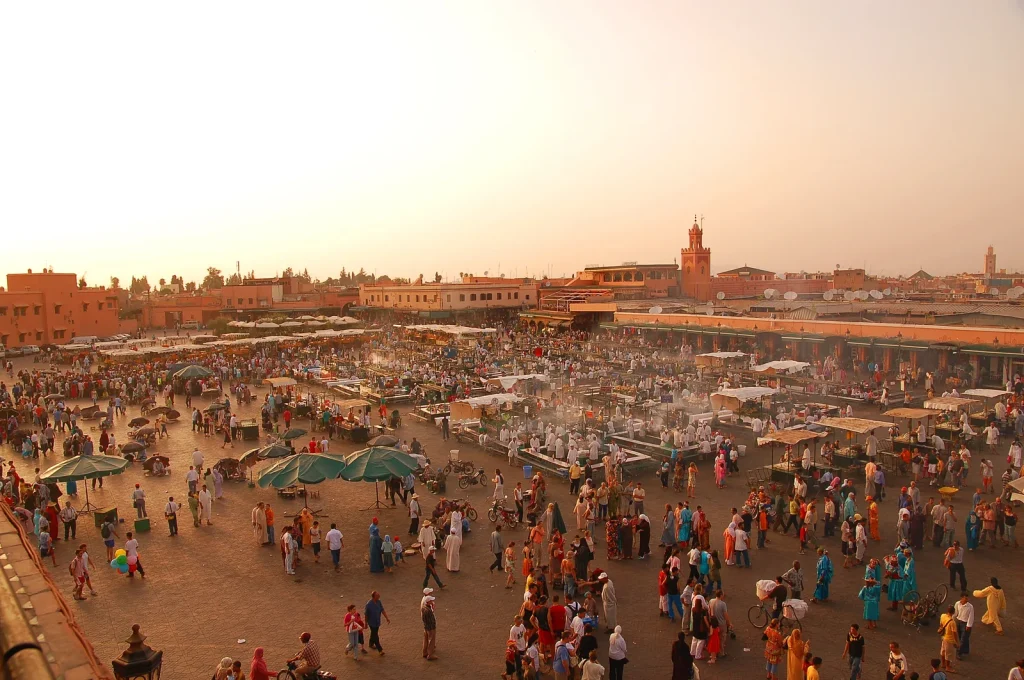
Every evening, as the sun drops behind the Atlas Mountains, a square in Marrakesh undergoes a transformation that no museum can replicate. Storytellers settle onto low stools and begin narrating epics in Amazigh or Darija Arabic; Gnaoua musicians take up their castanets and lutes; snake charmers position themselves near the food stalls that have sprung up in rows across the pavement. The square is Jemaa el-Fna, and in May 2001 it became one of the 19 original UNESCO Masterpieces of the Oral and Intangible Heritage of Humanity. Seven years later, in 2008, it was formally inscribed on UNESCO’s Representative List of Intangible Cultural Heritage under File No. 00014 — one of the lowest file numbers in the entire list, reflecting its status as an inaugural member.
- Jemaa el-Fna was one of the 19 original UNESCO Masterpieces of Oral and Intangible Heritage, proclaimed in May 2001.
- It was formally inscribed on the Representative List in 2008 (File No. 00014, Decision 3.COM 1) when the Masterpieces program was absorbed into the 2003 Convention.
- UNESCO protects it as a “cultural space” — not a single practice but an ensemble of at least seven distinct living traditions.
- A 2004–2008 UNESCO preservation project supported transmission of storytelling and performance traditions to younger generations.
- In May 2025, Morocco launched a 160 million dirham ($17.7M USD) renovation of the square, the largest investment since independence.
How Jemaa el-Fna Became a UNESCO Intangible Cultural Heritage Masterpiece
The designation of Jemaa el-Fna as intangible cultural heritage was not routine — it introduced a concept that would reshape how UNESCO thinks about living traditions. Before 2001, the international heritage framework was dominated by the 1972 World Heritage Convention, which protected monuments, landscapes, and physical sites. Jemaa el-Fna could not fit that mold: its value was not in its paving stones but in what happened on them. The story of how it became a UNESCO landmark is the story of how the concept of “cultural space” entered the global heritage vocabulary.
The 2001 UNESCO Proclamation: Introducing the Cultural Space Concept
In May 2001, UNESCO proclaimed 19 Masterpieces of the Oral and Intangible Heritage of Humanity — the inaugural list of what would become the world’s most comprehensive inventory of living cultural practices. Jemaa el-Fna was among them, and its inclusion marked the first time UNESCO formally applied the concept of a “cultural space” to a heritage nomination. Rather than identifying a single art form — a dance, a musical tradition, a craft technique — UNESCO recognized the entire square and its ensemble of performers as the unit of heritage.
UNESCO described it as “a unique concentration of popular Moroccan cultural traditions performed through musical, religious and artistic expressions” — a hub of cultural exchange representing centuries of accumulated oral knowledge. The concept departed from the practice of protecting discrete elements and acknowledged that some forms of heritage are ecosystems: they exist through the interaction of multiple practices, communities, and spaces. This innovation would later inform the design of the 2003 Convention for the Safeguarding of Intangible Cultural Heritage, which built its five-domain framework on similar principles.
The 2001 proclamation also drew on a much older precedent: in 1922, under French colonial administration, Moroccan authorities passed the first legal protections specifically aimed at preventing commercial and urban encroachment on the square’s cultural uses — one of the earliest instances of intangible heritage protection anywhere in the world. That 1922 framework recognized what UNESCO would formalize 79 years later: that the square’s value was in its living use, not its physical fabric.
From Masterpiece to UNESCO Representative List: The 2008 Inscription
The 2003 Convention created a new institutional framework for intangible heritage, and in 2008 — when the framework came fully into operation — all 90 Masterpieces from the three proclamation rounds (2001, 2003, 2005) were incorporated into the new Representative List of the Intangible Cultural Heritage of Humanity. Jemaa el-Fna received File No. 00014 and Decision 3.COM 1, designations that mark it as an early entrant with foundational status in the system.
Between the 2001 proclamation and the 2008 inscription, UNESCO funded the “Preservation, Revitalization and Promotion of Jemaa el-Fna Square, Marrakech” project (2004–2008). The project’s primary focus was transmission: supporting master storytellers, musicians, and performers to pass their knowledge and skills to apprentices. UNESCO researchers working on the project documented hundreds of oral traditions and performance techniques that had never been formally recorded — creating an archive while simultaneously working to ensure the traditions remained live rather than merely archived.
What the UNESCO Designation Protects: Seven Categories of Practice
Unlike most UNESCO intangible heritage inscriptions, which protect a single named tradition, Jemaa el-Fna’s designation encompasses an ensemble of at least seven distinct practice categories. UNESCO’s documentation is specific about the range:
- Storytellers (hikayat/imayazen bards): master narrators who hold circles of seated listeners rapt with tales ranging from historical epics to moral fables, told primarily in Darija (Moroccan Arabic) or Amazigh — considered the living core of the square’s intangible heritage
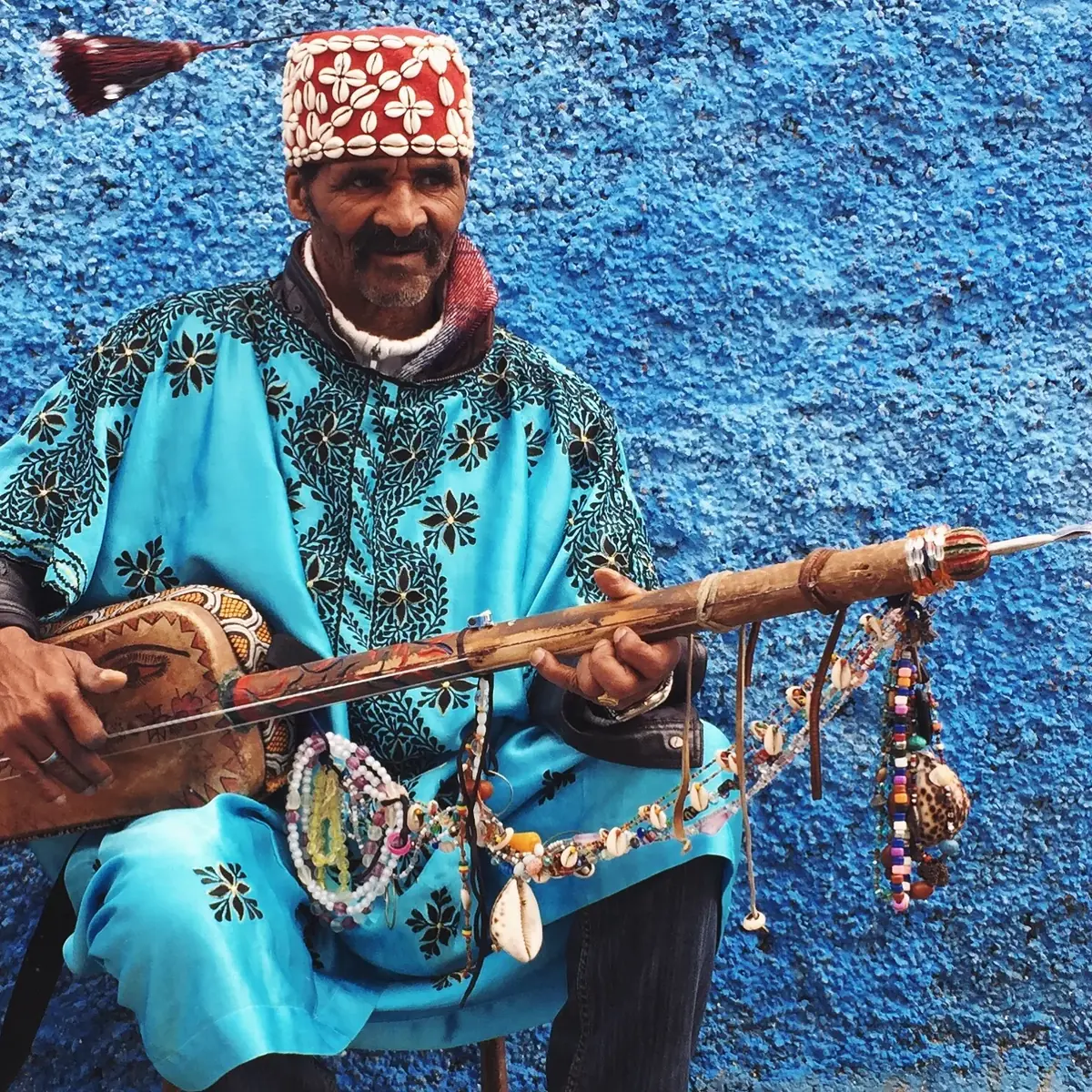
- Gnaoua musicians and dancers: practitioners of sub-Saharan African origin who use qraqeb (iron castanets) and the senthir/hajouj (a bass lute), performing trance-inducing rituals with deep roots in Islamic healing practices
- Berber musicians (mazighen): Amazigh musical ensembles preserving pre-Arabic Moroccan musical traditions
- Snake charmers: performing with cobras and other snakes, a profession with centuries of presence in Moroccan public spaces
- Henna tattooists: applying traditional decorative body art using natural henna paste
- Traditional medicine and herbalism practitioners: vendors and healers offering remedies from North African medicinal plant traditions
- Fortune-tellers, water-carriers, and traditional food vendors: the square’s commercial ecosystem, which UNESCO notes includes “dental care, traditional medicine, fortune-telling, preaching” — the sheer range of services is itself the heritage, creating a cultural space that no single practice could constitute alone
The Living Heritage of Jemaa el-Fna: History, Identity, and Contemporary Challenges
Jemaa el-Fna has not always been protected. For most of its nearly thousand-year history, it existed because Marrakesh needed it — as marketplace, gathering point, and the social anchor of the medina. UNESCO’s designation formalizes a status the square earned through centuries of continuous use. But the same forces that make Marrakesh one of Africa’s most-visited cities now threaten the very practices the UNESCO designation was designed to protect.
A Thousand Years of Gathering: The History of Jemaa el-Fna
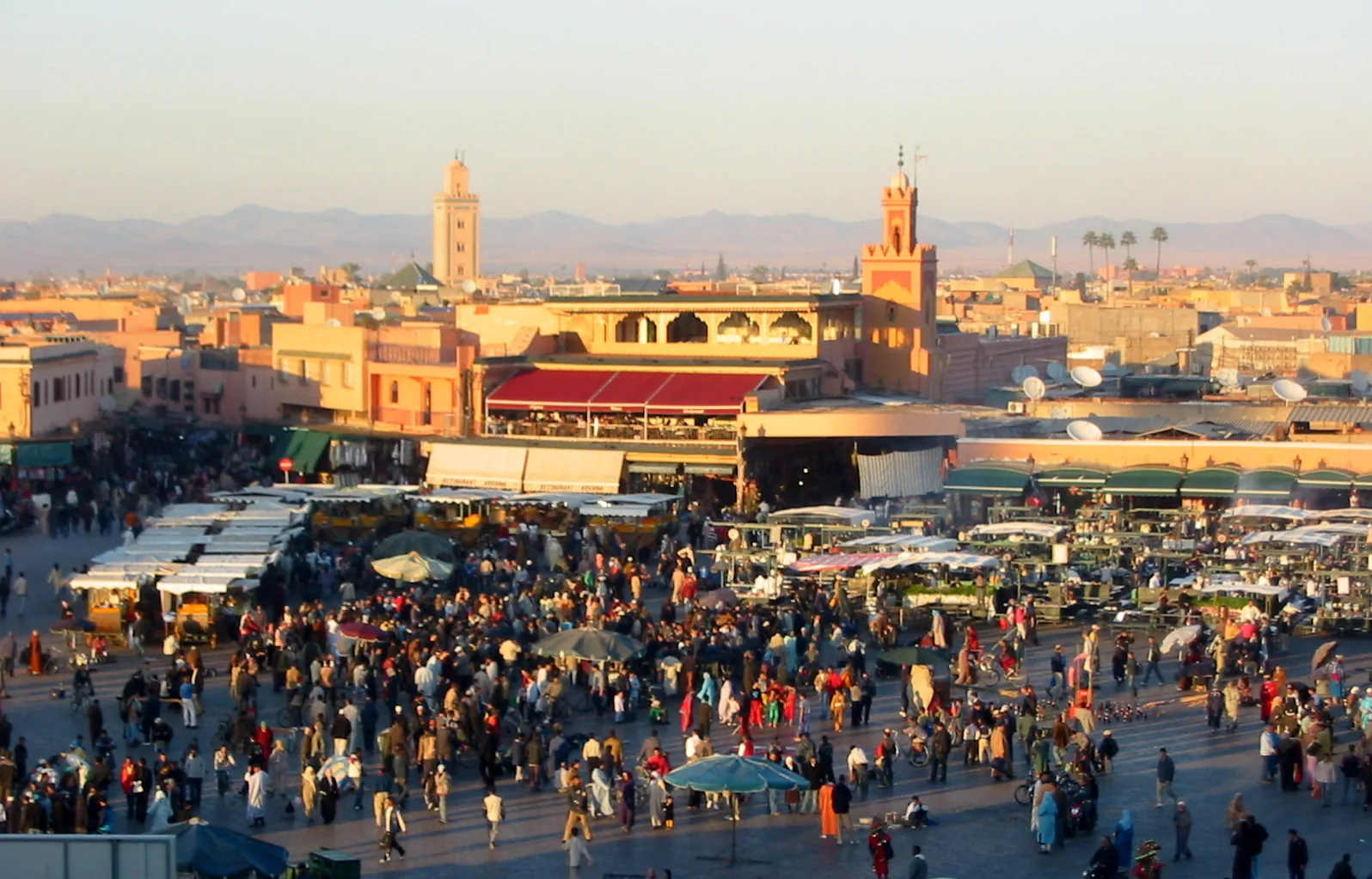
The square’s history begins with the Almoravid dynasty, which founded Marrakesh in 1070 and established the public space originally known as Rahbat al-Ksar (the palace courtyard). As the city grew, the square became the main social, commercial, and ceremonial space of the medina, adjacent to the Koutoubia Mosque — the city’s defining architectural landmark.
The name Jemaa el-Fna carries a layered etymology. Jamaa means mosque or congregation; fna’ means ruin or open space. The most widely accepted origin traces the name to Saadian Sultan Ahmad al-Mansur (ruled 1578–1603), who began constructing a monumental Friday mosque in the square but abandoned the project — likely due to plague epidemics — leaving a ruined foundation that gave the space its lasting name: “the congregation of the ruin” or “the ruined mosque assembly ground.”
The square also sits within the Medina of Marrakesh, inscribed on UNESCO’s World Heritage List in 1985 — giving Jemaa el-Fna a rare dual UNESCO status: tangible heritage protection through the World Heritage Convention and intangible heritage protection through the ICH Representative List. The combination recognizes both the physical fabric of the medina and the living practices that animate its public spaces.
Threats to the Cultural Space: Tourism, Attacks, and Urban Pressure
UNESCO’s documentation for Jemaa el-Fna identifies four principal threats: rapid sociocultural change, touristification, urban development and real estate speculation, and the risk of acculturation. These are not abstract risks — they have measurable effects on the square’s living heritage.
The April 2011 bombing at the Argana café on the edge of the square killed 17 people and forced temporary closure of parts of the square. The security measures introduced afterward — barriers, increased police presence, altered pedestrian flows — changed the spatial dynamics that had allowed storytellers to draw spontaneous crowds. UNESCO researchers noted a decline in Amazigh-language oral performance after 2011 as some practitioners relocated to more sheltered venues.
The September 2023 earthquake (magnitude 6.8) struck the Al Haouz province southwest of Marrakesh, damaging medina structures and the nearby Kharbouch Mosque. Reconstruction efforts in the surrounding medina altered foot traffic patterns and displaced some regular vendors and performers. UNESCO’s safeguarding monitoring — required for all elements on the Representative List — flagged the disruption as a potential threat to the continuity of established performance communities.
Tourism pressure presents a slower but equally persistent challenge. Many hikayat (storytellers) now perform in French or adapt their repertoire for international audiences. UNESCO researchers have documented a decline in Amazigh-language epic narratives — the oldest layer of oral tradition on the square — as performers shift toward content accessible to visitors who do not speak Darija or Tamazight. The same dynamics that bring global audiences to the square simultaneously erode the linguistic and cultural specificity that UNESCO recognized as heritage in 2001.
The 2025 Renovation: Modernizing Without Erasing Living Heritage
In May 2025, the municipality of Marrakesh launched a major renovation of Jemaa el-Fna with a budget of 160 million dirhams (approximately $17.7 million USD) — the largest investment in the square’s infrastructure since Moroccan independence. The project encompasses road resurfacing, modernized public lighting, upgraded drainage, and digital infrastructure to develop what planners call a “smart square” concept, integrating management tools for crowd flow, vendor coordination, and accessibility.
The renovation presents a heritage dilemma: unlike a museum restoration, the square cannot be emptied and reconstructed — it must remain a functioning living heritage site throughout the work. Planners committed to selecting architectural materials and configurations that preserve the square’s visual identity, and UNESCO monitoring requirements ensure that renovation decisions do not inadvertently reduce the usable performance space available to traditional practitioners.
The project is scheduled for completion by the end of 2025. Its full impact on the performer community remains to be assessed — but Morocco’s 160-million-dirham commitment signals a national determination to maintain both the square’s status in the global tourism economy and its standing on UNESCO’s lists. For the full official documentation of this element, see ich.unesco.org/en/RL/cultural-space-of-jemaa-el-fna-square-00014. For broader context on how UNESCO’s intangible heritage lists are constructed and updated, the main UNESCO intangible cultural heritage overview traces the full system from the 2003 Convention to the present.
Frequently Asked Questions
What does Jemaa el-Fna mean in English?
The name combines jamaa (mosque or congregation) and fna’ (ruin or open space). The most accepted etymology traces it to Saadian Sultan Ahmad al-Mansur (1578–1603), who began and abandoned a mosque on the site — leaving a ruined foundation that gave the square its enduring name.
Why is Jemaa el-Fna on the UNESCO intangible cultural heritage list?
UNESCO recognized it in 2001 as a “cultural space” — a living ensemble of storytellers, musicians, snake charmers, and traditional practitioners whose collective presence constitutes heritage that cannot survive in a museum. It was formally inscribed on the Representative List in 2008 under File No. 00014.
What is the cultural space of Jemaa el-Fna Square?
UNESCO’s “cultural space” designation recognizes the entire square and its ensemble of at least seven distinct living practices — from Gnaoua trance musicians and Amazigh storytellers to henna tattooists and traditional medicine vendors — as collectively constituting the heritage, rather than any single practice.
Is Jemaa el-Fna also a UNESCO World Heritage Site?
Yes. Jemaa el-Fna sits within the Medina of Marrakesh, which is a UNESCO World Heritage Site (inscribed 1985). This gives the square dual UNESCO status: tangible heritage protection through the World Heritage Convention, and intangible heritage protection through the ICH Representative List.
What is the 2025 renovation of Jemaa el-Fna?
In May 2025, Marrakesh launched a 160 million dirham ($17.7 million USD) renovation covering road resurfacing, modernized lighting, and digital infrastructure. The project must maintain the square as a functioning living heritage site throughout construction, with UNESCO monitoring required to protect the performance space used by traditional practitioners.