UNESCO Intangible Cultural Heritage and Rebellion: Traditions of Resistance
There is no single element called “rebellion” on UNESCO’s Intangible Cultural Heritage lists. The ICH framework inscribes living cultural practices — performing arts, oral traditions, social rituals, craft knowledge, festive events — rather than abstract concepts or historical events. However, several inscribed ICH elements carry an explicit relationship to historical resistance, oppression, and rebellion: UNESCO’s own documentation acknowledges their origins in enslaved or colonized communities whose cultural practices survived as forms of memory, identity, and coded resistance. The most direct example is capoeira (File 00892, Brazil, 2014), which UNESCO inscribed with explicit recognition of its function as “memory of resistance to historical oppression” — the only element in the ICH lists to carry UNESCO’s own characterization of resistance to oppression as a defining feature of its heritage value.
- There is no UNESCO ICH element called “rebellion” on any UNESCO list — the ICH framework inscribes living community practices, not concepts or historical events.
- Capoeira (File 00892, Representative List, 2014, Brazil) is the UNESCO ICH element most explicitly linked to rebellion: UNESCO inscribed it with the language of “memory of resistance to historical oppression” and tagged it under “Resistance to oppression” and “Slavery” as thematic descriptors — acknowledging its origins in the culture of enslaved Africans in colonial Brazil.
- Capoeira originated among enslaved African communities in Brazil, likely between the 17th and 19th centuries — developed as a form that concealed combat within a dance-like idiom, using the berimbau (a musical bow) to warn of approaching overseers and the rhythmic framework to disguise self-defense practice as communal festivity.
- Other UNESCO ICH elements rooted in communities that experienced historical oppression or colonialism include Samba de Roda of Recôncavo of Bahia (File 00082, 2008), Voodoo (Benin, File 01879, 2023), and many carnival traditions — though UNESCO’s inscriptions characterize these primarily through their living cultural value rather than through the language of resistance.
- UNESCO’s ICH framework explicitly requires that inscribed elements be living, community-maintained practices — rather than historical artifacts or commemorations of past events — which means traditions of “rebellion” survive in ICH primarily as cultural forms adapted and transmitted across generations by communities who maintain them.
Capoeira: Rebellion, Resistance, and UNESCO’s Recognition of Oppression Memory
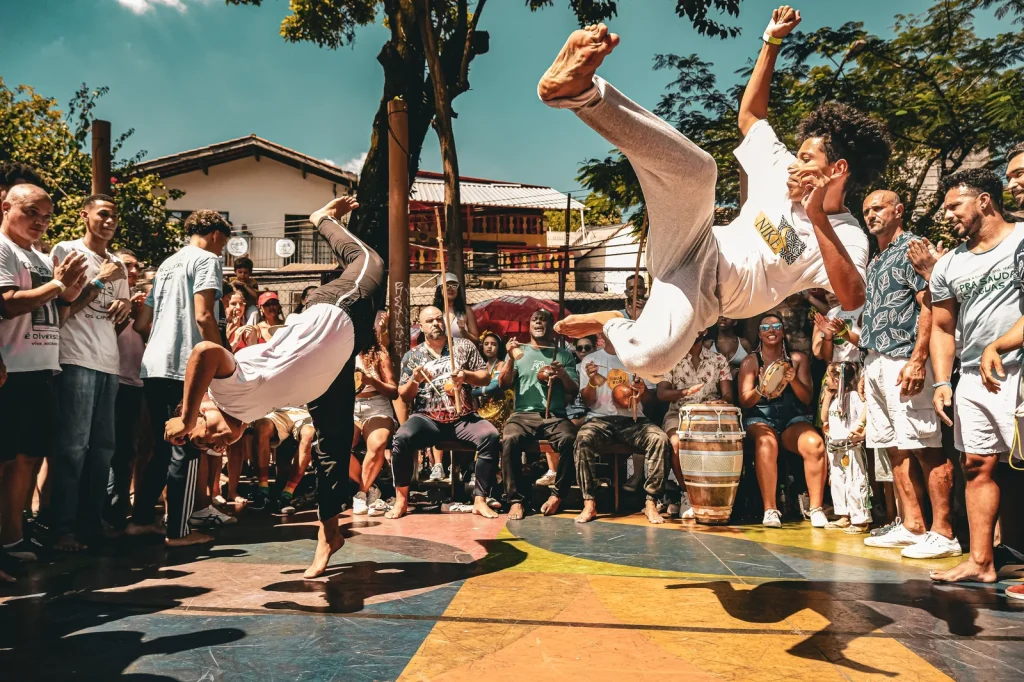
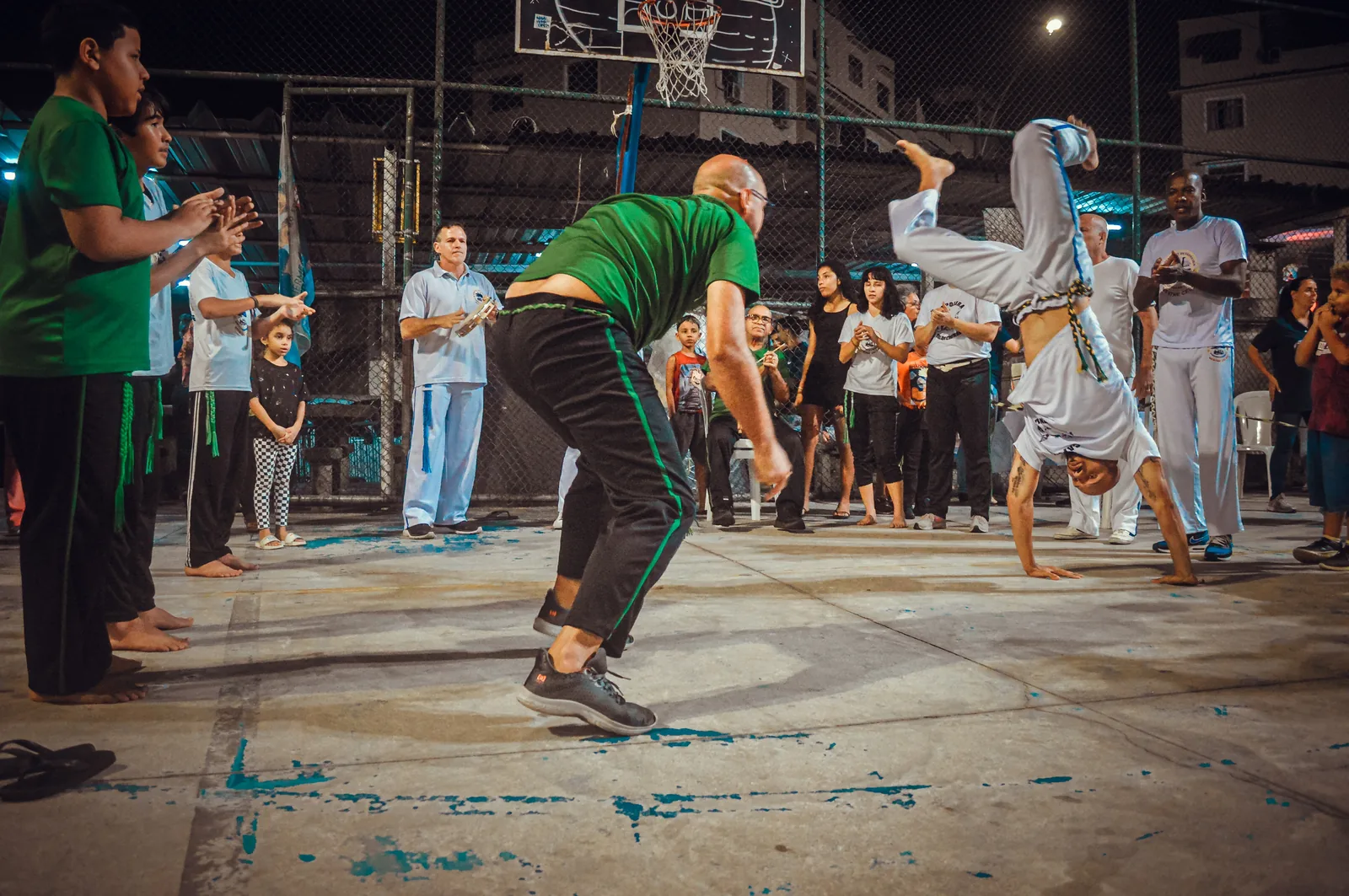
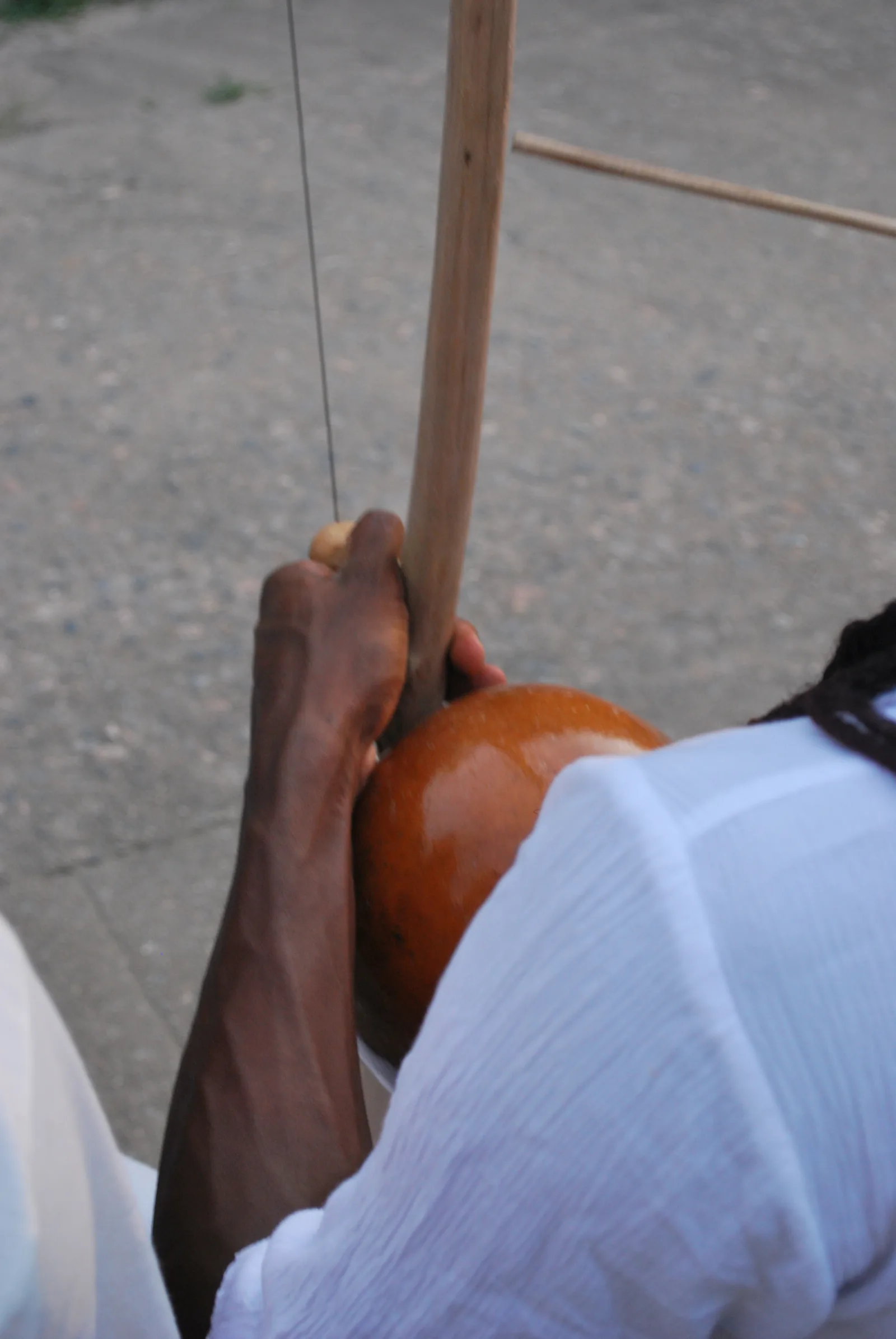
Capoeira (File 00892, Representative List, Decision 9.COM 10.8, 2014) is a Brazilian practice that combines elements of martial art, acrobatics, dance, music, and game in a way that UNESCO explicitly connected to the memory of resistance. It was inscribed at the 9th session of the Intergovernmental Committee (9.COM) in Paris, 2014, submitted by Brazil. Capoeira originated among enslaved Africans and their descendants in Brazil — the practice is documented in urban Brazil from the 18th century onward, though its roots in the cultural practices of enslaved communities are traced to the plantation society of colonial Brazil. The widely documented origin narrative describes capoeira as a form that disguised combat as dance: the ginga (the characteristic swaying base movement) and the fluid, dance-like quality of the fighting technique concealed its defensive purpose from slaveholders, while the rhythmic accompaniment of the berimbau (a single-string musical bow played with a stone) could signal warning of an approaching overseer. Whether this narrative is historically accurate in all its details or a later codification of origin mythology, it has been the self-understanding of capoeira practitioners since at least the 19th century and forms an intrinsic part of what UNESCO recognized as the tradition’s intangible heritage value.
Capoeira is performed in the roda (circle) — a formation in which two players engage in a ritualized exchange of movements (jogo, the “game”) while other practitioners form a circle, clap, and play musical instruments. The instrumental ensemble includes the berimbau, pandeiro (frame drum), atabaque (tall conga-like drum), and agogô (double bell). The berimbau’s rhythmic pattern determines the style and energy of the game being played; practitioners read the berimbau’s signal and adjust accordingly. Two main traditions exist: Capoeira Angola, which emphasizes low, slow, ground-based movements and a game of strategy and dialogue, associated with Mestre Pastinha (1889–1981) who taught it as the “original” African-rooted form; and Capoeira Regional, developed by Mestre Bimba (1900–1974) in the 1930s who incorporated elements of other fighting styles and systematized training into a curriculum. UNESCO’s 2014 inscription recognized “capoeira circles” — the living transmission environment, structured by the mestre-disciple relationship and the roda itself — as the core of the intangible heritage, rather than specifying either tradition exclusively. For the official inscription documentation, ich.unesco.org/en/RL/capoeira-circle-00892 is the authoritative source. For the framework that governs all UNESCO ICH inscriptions, the UNESCO intangible cultural heritage overview explains the 2003 Convention.
Other ICH Elements Rooted in Historical Resistance and Living Cultural Memory
Beyond capoeira, several UNESCO ICH elements carry documented connections to communities that maintained cultural practices under conditions of colonialism, enslavement, or systematic oppression. Samba de Roda of Recôncavo of Bahia (File 00082, Representative List, 2008) — the oldest form of samba, practiced in the historically enslaved Afro-Brazilian communities of the Recôncavo region of Bahia — was inscribed with recognition of its Afro-Brazilian origins and its function as a living community practice in one of Brazil’s most historically marginalized regions. UNESCO inscribed it as a “cultural expression that has become the symbol of Brazilian national identity” while acknowledging its roots in the slave trade. Voodoo in Benin (File 01879, Representative List, 2023) was inscribed by Benin in recognition of a religious tradition that was systematically suppressed by colonial authorities and whose survival represents a form of cultural continuity under conditions of historical oppression. The Haitian variant of Vodou (not separately inscribed) carried a documented connection to the Haitian Revolution of 1791-1804 — the only successful slave rebellion in history that resulted in an independent state — though Haiti’s capacity to engage with UNESCO ICH processes has been constrained by political and economic instability.
It is important to note a distinction in how UNESCO’s ICH framework handles these traditions: the 2003 Convention requires inscribed elements to be “compatible with existing international human rights instruments” and to respect “mutual respect among communities, groups and individuals” — criteria that shaped how nominations for practices rooted in violent historical contexts are framed. The framework inscribes the living cultural practice as maintained by communities today, not the historical rebellion or trauma that shaped its origins. This means the “memory of resistance” language in capoeira’s inscription is unusually explicit in acknowledging the historical context of oppression; most other nominations that involve similar histories of survival under oppression frame their cultural value in terms of community identity, social cohesion, and intergenerational transmission rather than foregrounding the resistance narrative. The result is that UNESCO’s ICH lists document many living traditions whose connection to historical rebellion or resistance is embedded in their practice but expressed in the documentation primarily through the language of cultural identity, diversity, and continuity.
Frequently Asked Questions
Is “rebellion” a UNESCO intangible cultural heritage?
No. There is no UNESCO ICH element called “rebellion” on any of UNESCO’s lists. The ICH framework inscribes living cultural practices — performing arts, oral traditions, social rituals, craft knowledge — rather than historical events or abstract concepts. However, some inscribed elements, particularly capoeira (File 00892, Brazil, 2014), are explicitly linked by UNESCO to “the memory of resistance to historical oppression.” Others, like Samba de Roda (File 00082, 2008) and Voodoo in Benin (File 01879, 2023), are rooted in communities with histories of colonialism and enslavement.
Which UNESCO ICH element is most connected to rebellion?
Capoeira (File 00892, Representative List, 2014) is the UNESCO ICH element most directly associated with rebellion and resistance. UNESCO’s inscription explicitly recognizes its function as “memory of resistance to historical oppression” and tags it under “Resistance to oppression” and “Slavery.” Capoeira originated among enslaved Africans in Brazil and developed as a form that disguised martial art within dance and game, preserving African cultural memory under conditions of enslavement. UNESCO inscribed it at 9.COM in Paris in 2014 through a Brazilian nomination.
What is capoeira as UNESCO intangible cultural heritage?
Capoeira (File 00892, Representative List, Decision 9.COM 10.8, 2014) is a Brazilian practice combining martial art, acrobatics, dance, music, and game performed in a roda (circle). It originated among enslaved Africans in colonial Brazil. UNESCO inscribed “capoeira circles” — the roda and the mestre-disciple transmission system — as the living intangible heritage. Two traditions exist: Capoeira Angola (associated with Mestre Pastinha, emphasizing slow ground-based movement) and Capoeira Regional (developed by Mestre Bimba in the 1930s with systematized training). The musical ensemble includes berimbau, pandeiro, atabaque, and agogô.
Does UNESCO recognize traditions linked to colonialism or enslaved communities?
Yes. Several UNESCO ICH elements are rooted in communities that maintained cultural practices under colonialism, enslavement, or suppression. Capoeira (Brazil) and Samba de Roda (Brazil) both have documented Afro-Brazilian origins under the conditions of the Atlantic slave trade. Voodoo in Benin (File 01879, 2023) survived systematic colonial suppression. UNESCO’s 2003 Convention inscribes these as living practices maintained by communities today, characterized in terms of cultural identity and social cohesion, though the resistance dimension may be explicitly or implicitly present in the heritage documentation.