Al-Ayyala: UNESCO Intangible Cultural Heritage of UAE and Oman (File 01012)
Al-Ayyala — the traditional performing art of the Arabian Gulf in which two facing rows of men chant Nabati poetry, wave thin bamboo sticks in simulated battle formation, and perform to the percussion of large drums, small drums, tambourines, and brass cymbals — was inscribed on UNESCO’s Representative List of the Intangible Cultural Heritage of Humanity in 2014 at the 9th session of the Intergovernmental Committee (9.COM), registered as File 01012. The inscription, a joint nomination by the United Arab Emirates and the Sultanate of Oman, recognized Al-Ayyala as a living performance tradition that embodies Bedouin values of chivalry, honor, and communal solidarity — practiced at weddings, national celebrations, and festive occasions across coastal and inland communities of the two countries.
- Al-Ayyala is inscribed on UNESCO’s Representative List as File 01012, at the 9th session of the Intergovernmental Committee (9.COM) in 2014 — a joint nomination by the United Arab Emirates and the Sultanate of Oman.
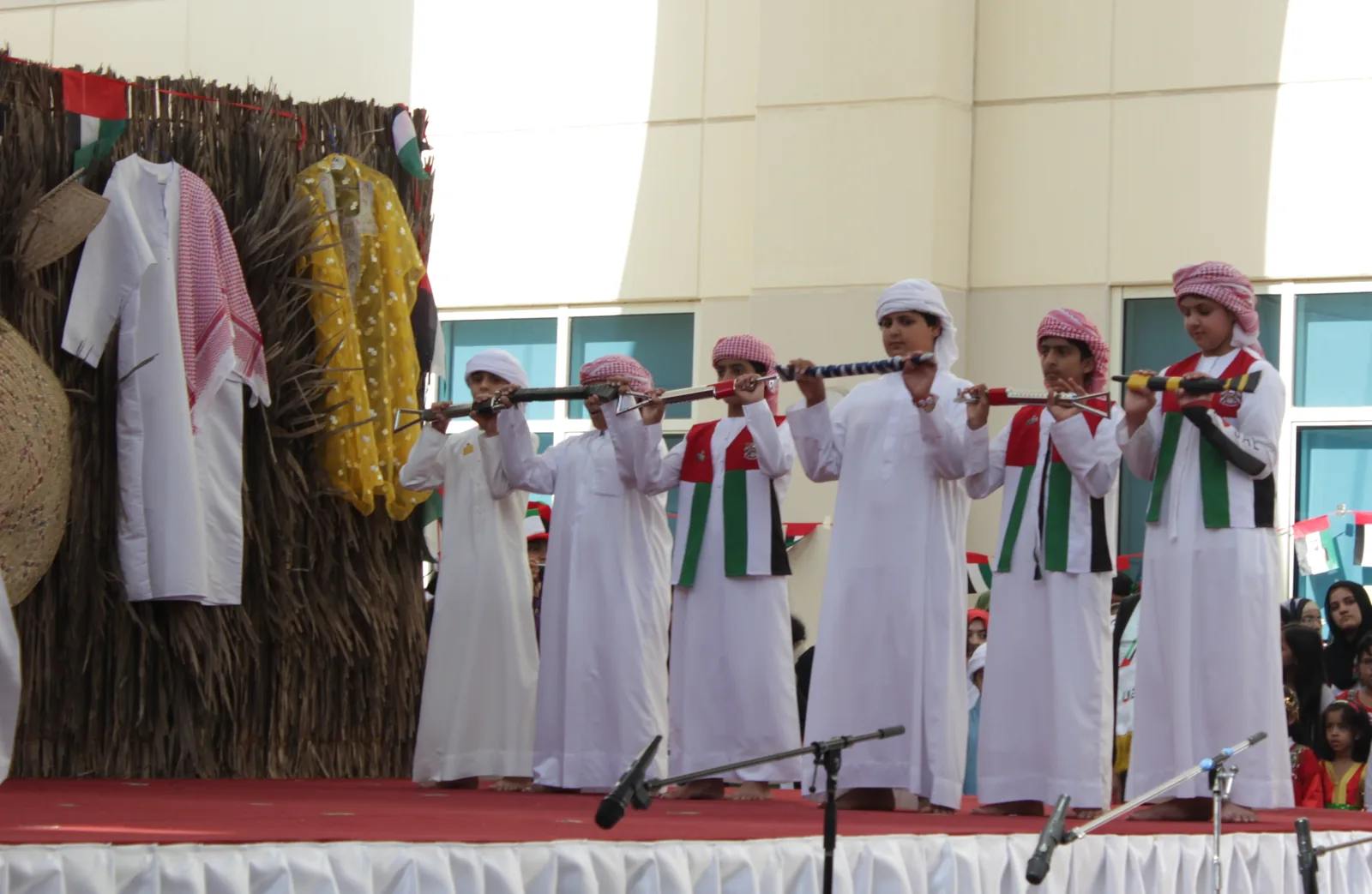
- The performance involves two facing rows of approximately twenty men each, carrying thin bamboo sticks representing spears or swords, with musicians between them playing large drums (al-ras), small drums, tambourines, and brass cymbals in a melody of seven tones in an irregular repeated pattern.
- Performers chant Nabati poetry — the classical oral poetry of the Arabian Peninsula — on themes of chivalry, valor, and Bedouin life; the choreography simulates a battle scene, with movements of the head, shoulder, arms, and sticks signifying victory or defeat.
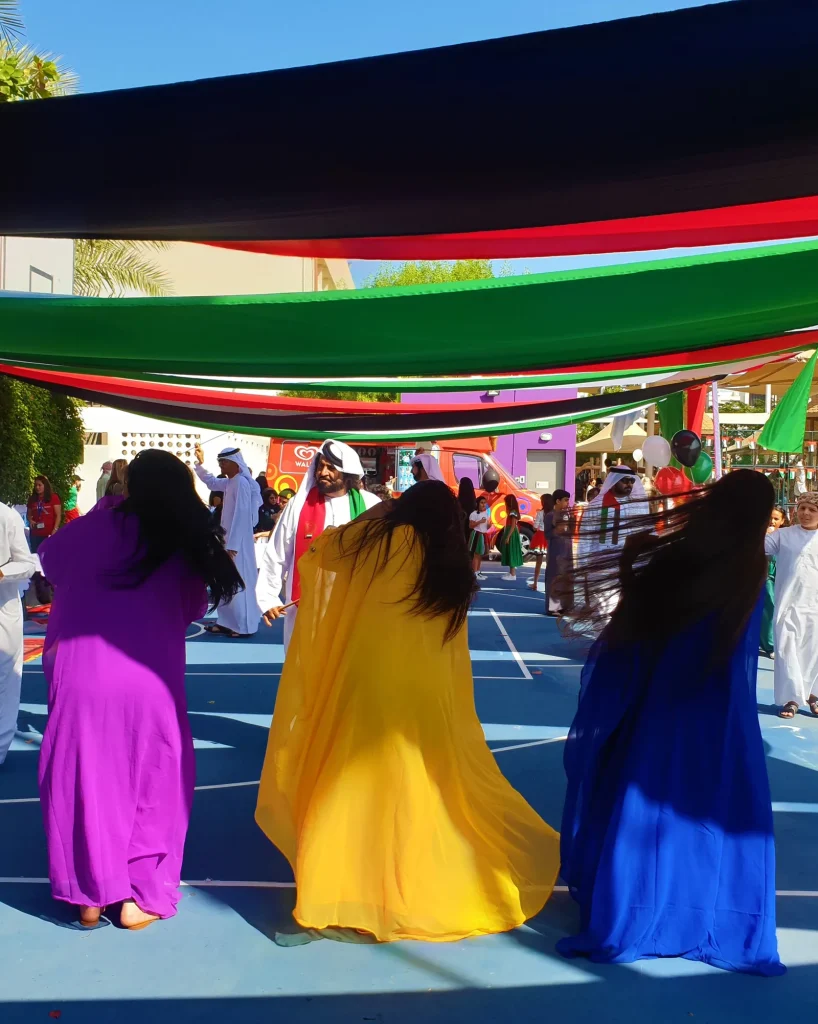
- In the UAE, girls in traditional dress stand at the front of the rows and move their hair rhythmically as part of the performance — a distinctive regional variant not present in all forms.
- Al-Ayyala has become a defining symbol of Emirati and Omani national identity, performed at state occasions, major celebrations, and — as recognized by UNESCO — across all ages, genders, and social classes, with each coastal and inland community maintaining its own regional variant.
Al-Ayyala: Bedouin Origins, Arabian Gulf Heritage, and UNESCO Inscription
Al-Ayyala — its name derived from the Arabic root denoting movement, bearing, or carrying — is rooted in the warrior culture of the Arabian Peninsula’s Bedouin and coastal communities. Its performance structure — two facing rows of armed men, drumming, and chanted poetry — is most directly connected to the traditions of pre-battle preparation and post-victory celebration that defined the military and social culture of the Gulf’s tribal societies. The use of bamboo sticks as stand-ins for swords and spears, and the poetry’s emphasis on chivalry, loyalty, and valor, encodes the values of Bedouin honor culture into a performance form that outlasted the martial context in which it originated and became a celebration of community identity at civil occasions. The practice is concentrated in north-western Oman and throughout the UAE — from coastal fishing communities to desert inland settlements — where each locality has developed its own variant, distinguishable by the speed of the drumming rhythm, the specific poems selected for chanting, and minor variations in movement and sound.
The chanted text of Al-Ayyala draws on Nabati poetry (also called vernacular or colloquial classical poetry of the Arabian Peninsula), a tradition of oral verse in the Gulf Arabic dialect that addresses themes of chivalry, honor, love, and community. The lead performer — whose role is typically inherited within families, carrying responsibility for training and transmitting the tradition — selects and initiates the verses, which the two rows of performers repeat and elaborate. The melody follows seven tones in an irregular repeated pattern, distinct from mainstream Arabic musical scales and characteristic of the Gulf performance tradition. Between the rows, musicians control the rhythm and tempo through the large al-ras drum, smaller drums, hand-held tambourines, and brass cymbals — instruments whose combined sound creates the driving pulse that coordinates the synchronized movements of all performers. Additional performers circulate around the rows carrying actual swords or rifles, occasionally tossing them skyward in displays of skill that reference the tradition’s martial origins.
UNESCO inscribed Al-Ayyala at the 9.COM session in 2014 as a joint nomination by the UAE and Oman — two countries that share the tradition but maintain distinct regional forms. The inscription recognized Al-Ayyala as falling across multiple ICH domains: performing arts, oral traditions, social practices and rituals, and traditional craftsmanship (referring to the manufacture of the drums and other instruments). A distinctive UAE-specific variant documented in the inscription file features girls in traditional dress who stand at the front of the performance rows and move their hair rhythmically — a component not consistently present in Omani forms and specific to certain UAE community contexts. For the broader context of Gulf Arab UNESCO ICH inscriptions, the UNESCO intangible cultural heritage examples article covers representative inscriptions across the full list.
Performance Structure, Transmission, and Social Role of Al-Ayyala
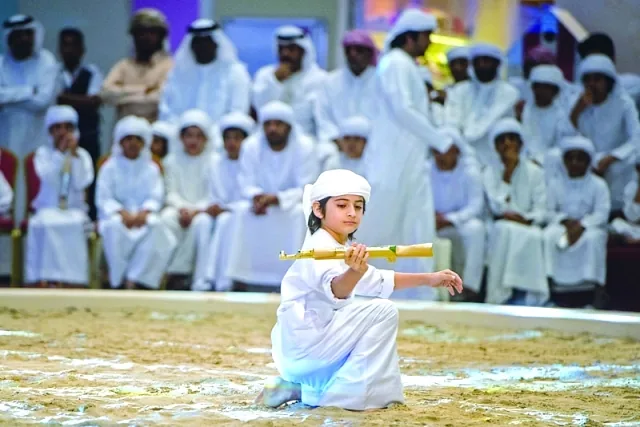
Al-Ayyala’s performance unfolds through a precise physical grammar. Two rows of approximately twenty men face each other, each holding a thin bamboo stick at waist height. As the percussion ensemble between the rows establishes the rhythm, both rows begin to move in unison: the head tilts, shoulders roll, arms and sticks swing through the air in coordinated arcs that accelerate and decelerate with the drumming. The synchronized movement — involving the full body from the neck down to the wrist — creates a visual echo between the two facing rows, as if each is the mirror of the other in a stylized confrontation. The chanting rises and falls with the rhythm, with the lead performer’s voice setting the verse that the rows respond to collectively. Additional performers carrying swords or rifles move between and around the rows, their individual displays of martial skill providing a counterpoint to the collective synchronized movement of the main lines.
The instruments of Al-Ayyala constitute their own sub-tradition of craft and knowledge. The al-ras (the large frame drum, roughly 60–80 cm in diameter, made from animal skin stretched over a circular frame) sets the foundational beat, while smaller drums of varying size and the brass cymbals provide rhythmic ornamentation and accents. The tambourines add a shimmering layer to the texture. The combined percussion ensemble is capable of producing a spectrum of dynamics — from quiet, reflective rhythms at the opening of a performance to driving, intense climaxes — and the variation in tempo and intensity is one of the primary means by which different communities express their regional identity within the shared tradition.
Transmission of Al-Ayyala follows the lead performer lineage: the murshid (guide or instructor), typically the male heir of an established performance family, is responsible for training new performers in both the vocal and physical elements of the tradition. Al-Ayyala is performed at the social occasions that structure community life in the UAE and Oman: weddings, national day celebrations, the arrival of important guests, and major religious festivals. UNESCO specifically noted that Al-Ayyala is inclusive across age, gender, and social class — practiced by communities ranging from Bedouin herders to coastal pearl-fishers — and that this social inclusivity is a core feature of the tradition’s function as a shared cultural identity. For official documentation, ich.unesco.org/en/RL/…01012 is the authoritative source.
Frequently Asked Questions
Is Al-Ayyala a UNESCO intangible cultural heritage?
Yes. Al-Ayyala, a traditional performing art of the Sultanate of Oman and the United Arab Emirates, is inscribed on UNESCO’s Representative List of the Intangible Cultural Heritage of Humanity as File 01012. It was inscribed in 2014 at the 9th session of the Intergovernmental Committee (9.COM) through a joint nomination by the UAE and Oman.
What is Al-Ayyala?
Al-Ayyala is a traditional performing art of the Arabian Gulf in which two facing rows of approximately twenty men each hold thin bamboo sticks representing spears or swords, chant Nabati poetry on themes of chivalry and valor, and perform synchronized movements to a percussion ensemble of large drums (al-ras), small drums, tambourines, and brass cymbals. The choreography simulates a battle scene. In the UAE, girls in traditional dress stand at the front and move their hair rhythmically as part of the performance.
What is the structure of an Al-Ayyala performance?
An Al-Ayyala performance consists of two facing rows of performers (approximately twenty men per row) holding bamboo sticks, with a percussion ensemble (al-ras drum, smaller drums, tambourines, brass cymbals) between the rows. Performers chant Nabati poetry initiated by a lead performer, while moving their heads, shoulders, arms, and sticks in synchronized movements. Additional performers carrying swords or rifles circle the rows. The melody follows seven tones in an irregular repeated pattern characteristic of Gulf musical tradition.
What is Nabati poetry in Al-Ayyala?
Nabati poetry is the classical oral poetry of the Arabian Peninsula in the Gulf Arabic vernacular dialect, addressing themes of chivalry, honor, love, and community life. In Al-Ayyala, the lead performer (murshid) initiates verses from the Nabati tradition — themes of valor and Bedouin identity — that the two rows of performers repeat and elaborate. Nabati poetry is itself recognized as a UNESCO intangible cultural heritage element and is the primary oral tradition at the core of Al-Ayyala’s content.
Where is Al-Ayyala practiced?
Al-Ayyala is practiced throughout the United Arab Emirates and in north-western Oman. Each community — whether coastal or inland — maintains its own regional variant, with differences in drumming tempo, poem selection, and movement nuances. In the UAE, the tradition is performed across all Emirates and has become a defining national symbol. UNESCO recognized that Al-Ayyala is inclusive across all ages, genders, and social classes in both countries.