 CulturalInscribed 2015
Türkiye
About This Site
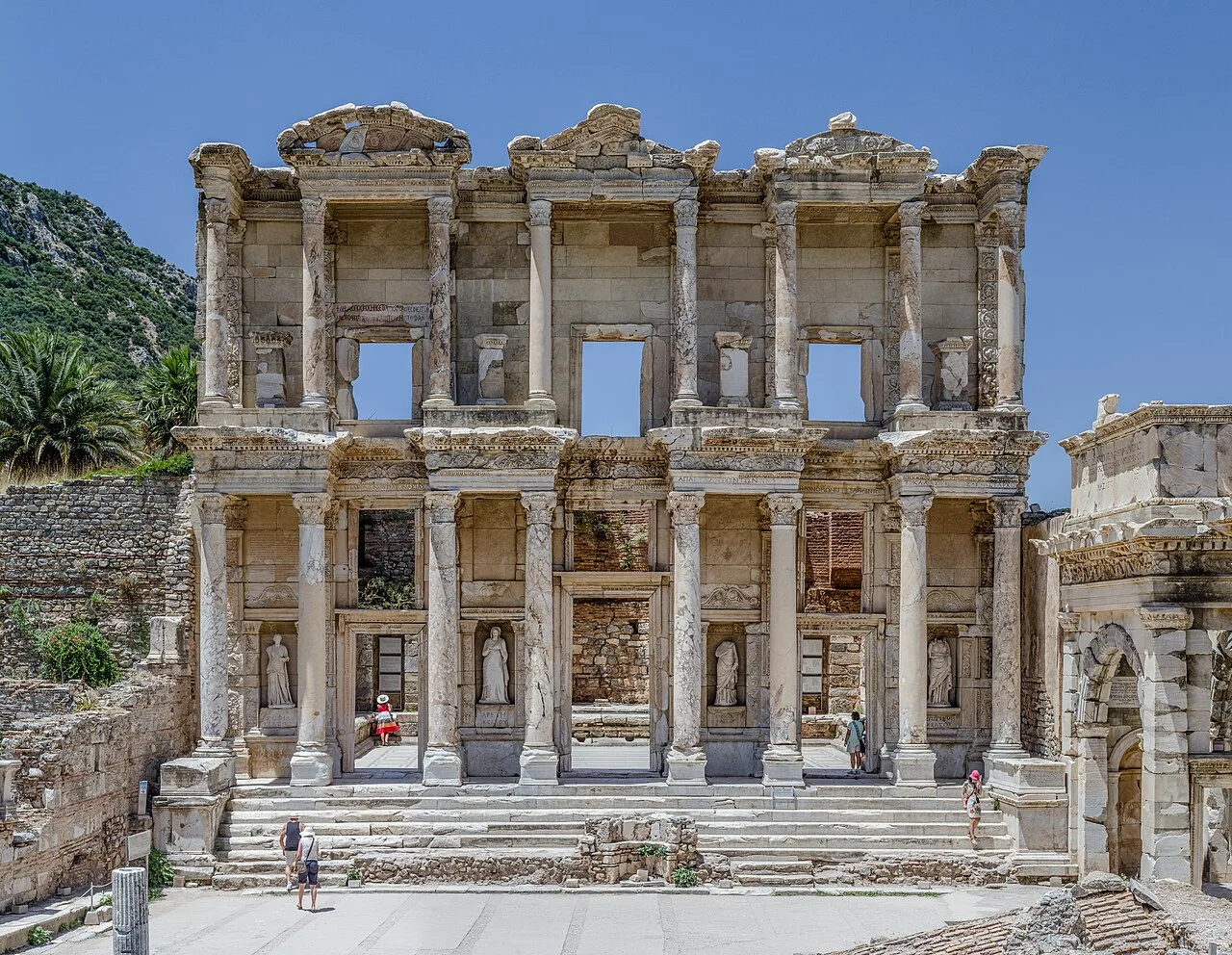
Located within what was once the estuary of the River Kaystros, Ephesus comprises successive Hellenistic and Roman settlements founded on new locations, which followed the coastline as it retreated westward. Excavations have revealed grand monuments of the Roman Imperial period including the Library of Celsus and the Great Theatre. Little remains of the famous Temple of Artemis, one of the “Seven Wonders of the World,” which drew pilgrims from all around the Mediterranean. Since the 5th century, the House of the Virgin Mary, a domed cruciform chapel seven kilometres from Ephesus, became a major place of Christian pilgrimage. The Ancient City of Ephesus is an outstanding example of a Roman port city, with sea channel and harbour basin.
Site Details
| Category | Cultural |
| Date Inscribed | 2015 |
| Area | 663 hectares |
| Cultural Criteria | c3, c4 |
| Location | Türkiye |
| Coordinates | 37.9292, 27.3594 |
Inscription Justification
Brief synthesis Within what was once the estuary of the river Kaystros, a continuous and complex settlement history can be traced in Ephesus beginning from the seventh millennium BCE at Cukurici Mound until the present at Selçuk. Favourably located geographically, it was subject to continuous shifting of the shore line from east to west due to sedimentation, which led to several relocations of the city site and its harbours. The Neolithic settlement of Cukurici Mound marking the southern edge of the former estuary is now well inland, and was abandoned prior to settlement on the Ayasuluk Hill from the Middle Bronze Age. Founded by the 2nd millennium BCE, the sanctuary of the Ephesian Artemis, originally an Anatolian mother goddess, became one of the largest and most powerful sanctuaries of the ancient world. The Ionian cities that grew up in the wake of the Ionian migrations joined in a confederacy under the leadership of Ephesus. In the fourth century BCE, Lysimachos, one of the twelve generals of Alexander the Great, founded the new city of Ephesus, while leaving the old city around the Artemision. When Asia Minor was incorporated into the Roman Empire in 133 BCE, Ephesus was designated as the capital of the new province Asia. Excavations and conservation over the past 150 years have revealed grand monuments of the Roman Imperial period lining the old processional way through the ancient city including the Library of Celsus and terrace houses. Little remains of the famous Temple of Artemis, one of the ‘seven wonders of the world’ which drew pilgrims from all around the Mediterranean until it was eclipsed by Christian pilgrimage to the Church of Mary and the Basilica of St. John in the 5th century CE. Pilgrimage to Ephesus outlasted the city and continues today. The Mosque of Isa Bey and the medieval settlement on Ayasuluk Hill mark the advent of the Selçuk and Ottoman Turks. Criterion (iii): Ephesus is an exceptional testimony to the cultural traditions of the…
Other World Heritage Sites in Turkey
Cultural · Inscribed 2025Sardis and the Lydian Tumuli of Bin TepeCultural · Inscribed 2023Wooden Hypostyle Mosques of Medieval AnatoliaCultural · Inscribed 2023GordionCultural · Inscribed 2021Arslantepe MoundCultural · Inscribed 2018Göbekli TepeCultural · Inscribed 2017Aphrodisias
More cultural heritage sites
Iran (Islamic Republic of)Takht-e SoleymanIndiaDholavira: a Harappan CityTürkiyeGordionIndiaGroup of Monuments at MahabalipuramKyrgyzstanSulaiman-Too Sacred MountainJordanQuseir Amra
Sites inscribed in the 2010s
- Central Highlands of Sri Lanka (2010, Sri Lanka)
- The Jantar Mantar, Jaipur (2010, India)
- Proto-urban Site of Sarazm (2010, Tajikistan)
- Sheikh Safi al-din Khānegāh and Shrine Ensemble in Ardabil (2010, Iran (Islamic Republic of))
- Tabriz Historic Bazaar Complex (2010, Iran (Islamic Republic of))
- At-Turaif District in ad-Dir'iyah (2010, Saudi Arabia)
- Cultural Sites of Al Ain (Hafit, Hili, Bidaa Bint Saud and Oases Areas) (2011, United Arab Emirates)
- The Persian Garden (2011, Iran (Islamic Republic of))
Data Source: UNESCO World Heritage Convention