 CulturalInscribed 1986
India
About This Site
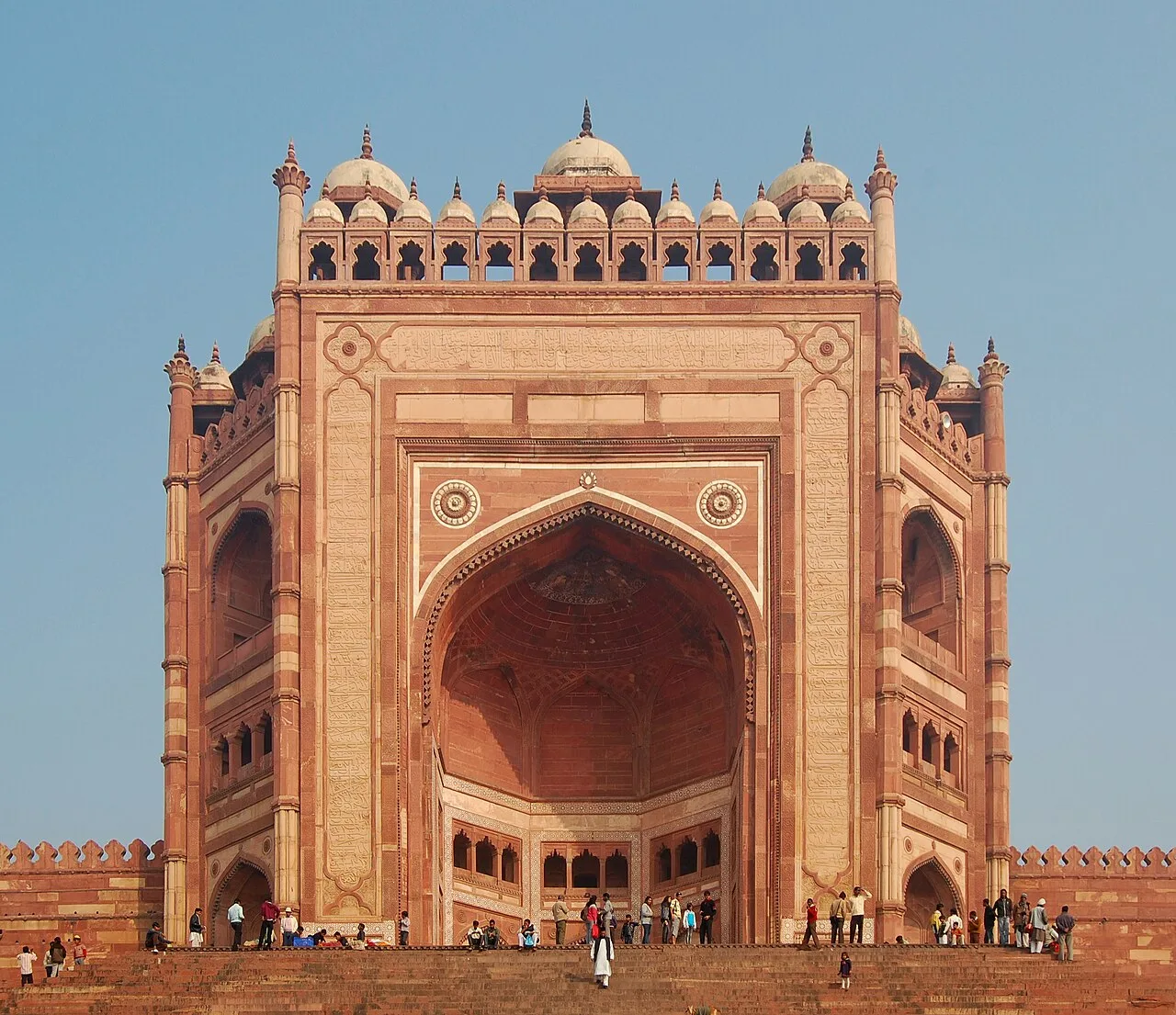
Built during the second half of the 16th century by the Emperor Akbar, Fatehpur Sikri (the City of Victory) was the capital of the Mughal Empire for only some 10 years. The complex of monuments and temples, all in a uniform architectural style, includes one of the largest mosques in India, the Jama Masjid.
Site Details
| Category | Cultural |
| Date Inscribed | 1986 |
| Cultural Criteria | c2, c3, c4 |
| Location | India |
| Coordinates | 27.0975, 77.6665 |
Inscription Justification
Brief synthesis Fatehpur Sikri is located in Agra District in the State of Uttar Pradesh in northern India. It was constructed southeast of an artificial lake, on the slopping levels of the outcrops of the Vindhyan hill ranges. Known as the “city of victory”, it was made capital by the Mughal emperor Akbar (r. 1556-1605 CE) and constructed between 1571 and 1573. Fatehpur Sikri was the first planned city of the Mughals to be marked by magnificent administrative, residential, and religious buildings comprised of palaces, public buildings, mosques, and living areas for the court, the army, the servants of the king and an entire city. Upon moving the capital to Lahore in 1585, Fatehpur Sikri remained as an area for temporary visits by the Mughal emperors. The inscribed property covers 60.735 ha, with a buffer zone of 475.542 ha. The city, which is bounded on three sides by a wall 6 km long fortified by towers and pierced by nine gates, includes a number of impressive edifices of secular and religious nature that exhibit a fusion of prolific and versatile Indo-Islamic styles. The city was originally rectangular in plan, with a grid pattern of roads and by-lanes which cut at right angles, and featured an efficient drainage and water management system. The well-defined administrative block, royal palaces, and Jama Masjid are located in the centre of the city. The buildings are constructed in red sandstone with little use of marble. Diwan-i-Am (Hall of Public Audience) is encircled by a series of porticos broken up at the west by the insertion of the emperor’s seat in the form of a small raised chamber separated by perforated stone screens and provided with pitched stone roof. This chamber communicates directly with the imperial palace complex clustered along a vast court. At the north side of it stands a building popularly known as Diwan-i-Khas (Hall of Private Audience), also known as the ‘Jewel House’. Other monuments of exceptional quality are Panch Mahal, an…
Other World Heritage Sites in India
Cultural · Inscribed 2025Maratha Military Landscapes of IndiaCultural · Inscribed 2024Moidams – the Mound-Burial System of the Ahom DynastyCultural · Inscribed 2023Sacred Ensembles of the HoysalasCultural · Inscribed 2023SantiniketanCultural · Inscribed 2021Kakatiya Rudreshwara (Ramappa) Temple, TelanganaCultural · Inscribed 2021Dholavira: a Harappan City
More cultural heritage sites
AzerbaijanGobustan Rock Art Cultural LandscapeIran (Islamic Republic of)Prehistoric Sites of the Khorramabad ValleyBangladeshHistoric Mosque City of BagerhatIran (Islamic Republic of)Historic City of YazdLibyaOld Town of GhadamèsBahrainPearling, Testimony of an Island Economy
Sites inscribed in the 1980s
- Site of Palmyra (1980, Syrian Arab Republic)
- Ichkeul National Park (1980, Tunisia)
- Buddhist Ruins of Takht-i-Bahi and Neighbouring City Remains at Sahr-i-Bahlol (1980, Pakistan)
- Taxila (1980, Pakistan)
- Archaeological Ruins at Moenjodaro (1980, Pakistan)
- Ancient City of Bosra (1980, Syrian Arab Republic)
- Historical Monuments at Makli, Thatta (1981, Pakistan)
- Fort and Shalamar Gardens in Lahore (1981, Pakistan)
Data Source: UNESCO World Heritage Convention