 CulturalInscribed 1983
India
About This Site
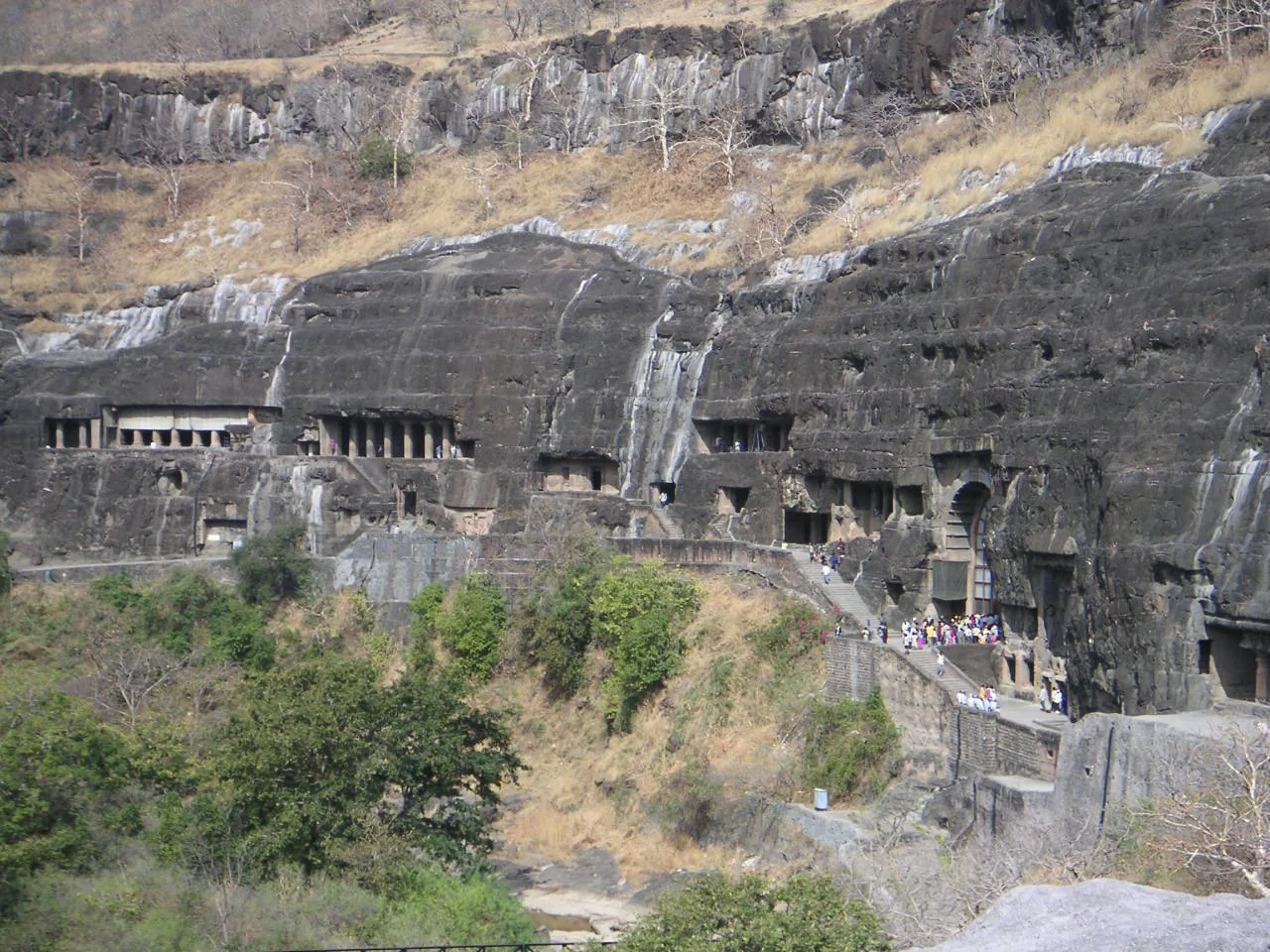
The first Buddhist cave monuments at Ajanta date from the 2nd and 1st centuries B.C. During the Gupta period (5th and 6th centuries A.D.), many more richly decorated caves were added to the original group. The paintings and sculptures of Ajanta, considered masterpieces of Buddhist religious art, have had a considerable artistic influence.
Site Details
| Category | Cultural |
| Date Inscribed | 1983 |
| Area | 8,242 hectares |
| Cultural Criteria | c1, c2, c3 |
| Location | India |
| Coordinates | 20.5531, 75.7003 |
Inscription Justification
Brief synthesis The caves at Ajanta are excavated out of a vertical cliff above the left bank of the river Waghora in the hills of Ajanta. They are thirty in number, including the unfinished ones, of which five (caves 9, 10, 19, 26 and 29) are chaityagrihas (sanctuary) and the rest, sangharamas or viharas (monastery). The caves are connected with the river by rock-cut staircases. The excavation activity was carried out in two different phases separated by an interval of about four centuries. The first phase coincides with the rule of the Satavahana dynasty from about the 2nd century BCE to the 1st century BCE, while the second phase corresponds to the Basim branch of the Vakataka dynasty with their Asmaka and Rishika feudatories in the 5th to 6th centuries CE. Altogether, six caves (caves 8, 9, 10, 12, 13 and 15A) were excavated in the first phase by Hinayana/Theravadin followers of Buddhism, wherein Buddha was worshipped in an aniconic/symbolic form. These caves are simple and austere, and carry mural paintings sparsely. The chaityagrihas are characterized by a vaulted ceiling and an apsidal end, the façade dominated by a horseshoe-shaped window, known as chaitya window. Internally, they are divided by colonnades into a central nave and side aisles, the latter continuing behind the apse for circumambulation. At the centre of the apse stands the object of worship in the form of a chaitya or stupa, also hewn out of the rock. The monasteries consist of an astylar hall meant for congregation, and range of cells on three sides serving as the dwelling-apartments (viharas) for monks. In the second phase, the rupestral activity was dominated by the Mahayana followers of Buddhism, where Buddha was worshipped in an icon/idol form. The earlier caves were reused, and several new ones were excavated. The architectural forms of the earlier phase continued, however, with a renewed architectural and sculptural fervour. The walls were embellished with exquisite mural paintings…
Other World Heritage Sites in India
Cultural · Inscribed 2025Maratha Military Landscapes of IndiaCultural · Inscribed 2024Moidams – the Mound-Burial System of the Ahom DynastyCultural · Inscribed 2023Sacred Ensembles of the HoysalasCultural · Inscribed 2023SantiniketanCultural · Inscribed 2021Kakatiya Rudreshwara (Ramappa) Temple, TelanganaCultural · Inscribed 2021Dholavira: a Harappan City
More cultural heritage sites
Sri LankaAncient City of SigiriyaIran (Islamic Republic of)Historic City of YazdAfghanistanMinaret and Archaeological Remains of JamIsraelWhite City of Tel-Aviv – the Modern MovementIran (Islamic Republic of)The Persian CaravanseraiIsraelBahá’i Holy Places in Haifa and the Western Galilee
Sites inscribed in the 1980s
- Site of Palmyra (1980, Syrian Arab Republic)
- Ichkeul National Park (1980, Tunisia)
- Buddhist Ruins of Takht-i-Bahi and Neighbouring City Remains at Sahr-i-Bahlol (1980, Pakistan)
- Taxila (1980, Pakistan)
- Archaeological Ruins at Moenjodaro (1980, Pakistan)
- Ancient City of Bosra (1980, Syrian Arab Republic)
- Historical Monuments at Makli, Thatta (1981, Pakistan)
- Fort and Shalamar Gardens in Lahore (1981, Pakistan)
Data Source: UNESCO World Heritage Convention